Showing posts with label culture. Show all posts

18 February 2010

why not?: notes on tedx fort bonifacio

Yesterday's TEDx at Fort Bonifacio was, in keeping with TED tradition, a celebration of ideas. Not of the abstract kind, but of the practical kind. Ideas that inspire, challenge, and make one think.

First off, Ana Arce posed a challenge: make the world a little more Deaf-(with a capital "D" as opposed to "deaf") friendly. Have closed captioning and subtitles in movies. Or better yet, have sign language interpreters. For more about Ana's talk, read this.

Dr. Lourdes Cruz, who has worked extensively with the Ayta community in Morong, Bataan, presented the 4-helix model for S&T-based economic development. It's a mouthful, but it basically means giving the community a say in their development. It's a doable alternative to the usual development model, which relies on a 3-way interface between government, the academe, and business.

The inventions of the prolific Dr. David Manalo were actually very simple solutions to common and simple problems. As he said in this talk, "Why complicate the solution when the problem is simple?" His inventions had been awarded grants from the World Bank, no less. An audience favorite was the carabao decoy: kept outside the house, mosquitoes are supposed to flock to it, effectively sparing the people inside the house from mosquito bites. A simple solution, indeed -- but no awards or grants for that one.

Young photojournalist VJ Villafranca showed the audience a different way of seeing the world -- through the lens of a digital camera. From this vantage point, he explored the grit and grime of BASECO, an urban poor community in Manila. Each photo is a story in black and white, framed in stark contrast and harsh reality.

The husband-and-wife team of Drs. Chris and Marivic Bernido ended TEDx with a presentation on the sorry state of science education in the country -- and what they have done to turn it around. The figures are certainly impressive: 1% of high school seniors performing excellently in the sciences, and higher percentages getting average and above-average scores. At an estimated 700,000 high school seniors, 1% is 7,000 students. Wow.

TEDx organizer Gene Battung introduces the next speaker while Veronica Perez, dean of the De La Salle-College of Saint Benilde School of Deaf Education and Applied Studies, signs for the Deaf community.

In the end, what defined my TEDx experience was the fact that the ideas presented in the talks entered not only the broad realm of possibility, but more importantly, of doability.

So why not have more sign language interpreters? Why not involve communities in rural development? Why not use water to generate electricity for communities in the mountains? Why not use photos to tell stories and document life? Why not improve students' performance in the sciences? It's possible after all. So why not?

+++

I'm a TED fan, so it was only natural that, when I heard about TEDx happening at the Fort, I wanted to go.

But just to be clear, this wasn't the first TEDx talk in Manila. And hopefully not the last.

30 September 2009

an "ondoy" survival story

What makes survivors out of ordinary people? Is it luck? Being at the right place at the right time? Will and determination? The Forces That Be?

+++

I was waiting in line at the supermarket the other day and a lady at the other counter was telling the guy beside her the story of how a child miraculously survived the floods caused by tropical storm "Ondoy" while its mother, beside her, perished. "For some, it was their time -- but not for this child," I heard the lady saying in Pilipino.

Doubtless, everyone has a story to tell about "Ondoy," whether it's his/her own or someone else's, or something heard or witnessed. These stories will be told over and over to anyone who will care to listen, passed on to those who were not there, and remembered for the lessons they contain. For these are survival stories -- stories that inspire us, move us, and give us hope; stories that strengthen us and validate who we are and more importantly, who we can be in the face of even the most devastating appearances.

+++

The following was part of an email written by Nadj B., an underwater hockey player and triathlete. With her permission, I am posting it here as a first-person account of the floods caused by "Ondoy." Like thousands of Filipinos living in Marikina, Cainta, and other parts of Metro Manila hardest hit by the storm, Nadj and Chari O., also an underwater hockey player and triathlete, had to climb onto roofs and wait until either the waters subsided or help came.

This is their story.

--------------------------------------------------

I was having lunch with Chari in her house when it struck. We were supposed to ride that morning with FF in Alabang and/or do endurance training for underwater hockey that afternoon. All of which thankfully didn't push through, else her elderly parents would've been alone in the house with one frightened helper and five terrified dogs -- three of which are now missing.

I don't even know where to begin telling the story. Pretty much how we all felt when we went back to the house and saw the ruin. The floor was covered in foot-deep mud, the ceiling looked like it was going to fall any minute; heavy cabinets, pots and pans, electronic system, tables, sofas, beds... eveything was either floating or just on top one another stuck in mud. There was a dining chair on top of their gate, a barking dog atop their perimeter wall, cars on top of each other outside. You've seen the news. But it's much much different when you're actually there and seeing all the shambles; much much different when you actually have to wade through rising flood in grounded water (most terrifiying for me); much much different when it's your story to tell. Chari and I cut our feet in attempts to reach loved ones who were yelling for help in other parts of the house; Chari cut her wrist when she broke the glass door in our desperate attempt to save all her dear dogs. Her parents were wet and shivering on top of the roof. Everything played out like it was in the movies only this time it was (really) real.

On the rooftop, you could see other people madly scrambling to get to the top. People hanging on to branches of trees yelling for help; a lola (grandmother) who was hanging on for dear life while she literally hung like a butiki (gecko) on the bottom side of their rooftop. We helped everyone up. We helped comfort those who needed comforting. Sometimes, a gentle talk and just a little encouragement were all they needed to bravely get from one point to another. We helped people cross roofs and make paths where people rapelled and pets were guided from one roof to the balcony of another. We managed to reach the 3rd floor of a neighbor's house where it was safe and dry.

There, the experience was altogether surrreal. Everyone had a story to tell. A woman was crying her eyes out as she told the stoy of all her dogs being trapped in a closed room. A woman from the other roof was having a seizure. After everything had somehow settled, Chari and I tended to our wounds. Luckily, we were able to ask for some betadine and cotton before the 2nd floor rooms became inaccessible. The adrenaline was going down and we were both starting to feel the pain. Chari's cuts on her right foot and right hand were all much much deeper than mine. We wrapped our bandaged wounds in torn grocery platic bags just to keep them dry.

We were dry, safe; we ate hot food, and we had toilet and water. Other people on other roofs were not as lucky as they sat wet and cold huddled under flimsy umbrellas. They stayed that way for more than 12 hours. I couldn't help but feel guilty for all the "comfort" we had. If only there was something more we could do other than try to survive the night.

At around 10am we were walking through the filthiest water we've ever been in: dead dogs, dead rodents, dead cats, garbage, feces... it was the longest, dreariest 500m. But again, we were still lucky. Other people were dead in other areas.

Afterward we proceeded to the hospital to get tetanus shots. The doctors didn't stitch Chari as her wounds were already more than 24 hours.

Thank you to all our friends who kept us in their prayers. I'm sure that it was your loving and sincere thoughts that kept us safe and serendipitously sent RY our way yesterday.

More stories to tell but we'll probably just tell you in person.

27 September 2009

typhoon "ondoy" (re)told through social media

26 September 2009. The day will go down in history as the day the skies opened and released the most rainfall in a single day that the nation had seen since 1967 -- 455 millimeters, as compared to 344 millimeters on 7 June of that year. That's more than what "Katrina" dumped on Louisiana a few years ago, according to this story. In fact, as much rain fell in just six hours as in a month.

It wasn't so much that it rained hard as that it rained continuously. And with this record rainfall came the worst flood the nation had ever experienced. Even at storm signal #1, which was what PAGASA said it was, Metro Manila streets were flooded in no time. One can only guess what the final estimates of damage to life, property, and infrastructure will be.

Nobody saw it coming. Nobody could have.

mobile technology + social networking
Many Metro Manila residents, unmindful that "the great flood" was coming, went about their usual business. Some remained unmindful as it was happening and were alerted later on.

It was only through their trusty mobile phones that most who were stranded sent SOS's to tell loved ones and friends of their situation. Cristine Reyes, for example, stranded on the roof of their Provident Village, Marikina home, was interviewed on TV via mobile phone patch.

By Saturday afternoon, my sister's Facebook account was showing a number of photos and videos of flooded areas -- most shot with mobile phones from windows of tall buildings. They were forwarded by friends who also received them on Facebook or on their mobile phones, or found on YouTube.

Later in the day, calls for help circulated via SMS -- a friend whose husband and young children were stranded on a flooded street, a family stuck on the roof of their house, among others.

= communicating in emergency situations
Communicating in emergency situations has come a long way since the days when one had to go to a radio or TV station to air a panawagan (roughly, a public service request or call for attention). In the rural areas, radio or TV may still rule -- but there, as in Metro Manila, the mobile phone is ubiquitous.

Add to this the popularity of social networking sites such as Facebook, and you have probably the best way to exchange information and communication, especially among Metro Manila residents.

This doesn't necessarily spell the end for traditional mass media, but with more and more people relying on SMS and social networking sites, we should certainly think about harnessing these media to benefit all.

After this experience, I wonder: If weather/flood alerts or such notices from PAGASA and other government agencies were to be disseminated via SMS or Facebook, would they reach more people faster?

Would we be more prepared for a situation like this?

Perhaps only while mobile phone batteries and Internet connections last.

08 April 2009

notes on cotabato city

Fact: Cotabato City is not located in North nor in South Cotabato. It used to be the capital of Cotabato Province, which used to be the largest province in the entire country. The province has since been divided into North Cotabato, South Cotabato, Maguindanao, and Sultan Kudarat. 

Fact: Cotabato City is found within the borders of the province of Maguindanao, but is not considered part of that province. (It used to be, though.)

Fact: Cotabato City is "the regional center of the Autonomous Region in Muslim Mindanao," but it is not part of the ARMM. It is actually part of Region XII or SOCCSKARGEN.

+++

The members of the Cotabato City Tourism Council were very accommodating and patient in answering all our questions. More than this, one could sense their genuine pride in sharing with us various facets of their collective story as Cotabateños -- from the Palasyo ng Masa (People's Palace) to the etymology of the name "Cotabato," from the uses of inaul to the "lost wax" brass making process, from the finer points of eating durian to the hows of preparing agar-agar (seaweed) and the different delicacies of the area.  

It was an experience I don't think I'll ever forget, and I do hope to return there someday.

07 August 2008

a worldwide moment

Among the many ways to celebrate 8 August 2008 (080808): World Wide Moment.

20 July 2008

ooh la la, paris!


I actually considered buying one of these -- a little piece of French history, all my own -- but realized it would be of no use to me, as my French is extremely basic.

Aside from hello and how are you, I know only the barest minimum for survival:

Je ne comprends pas.
Parlez-vous anglais?


And the all-important

Je suis végétarienne/végétalienne. (I am a vegetarian/vegan.)


My inability to speak and understand French did cause some inconvenience. I expected this, and was prepared for it (see above phrases). What was frustrating was when people would try to strike up a conversation with me, in French, of course. Unable to communicate in English, they would smile, shrug or shake their heads, and give up.

Despite warnings from some quarters that the French are rude, I found the opposite to be true. The French people I encountered were helpful, friendly, and gracious.

Even those I could not communicate with tried to be of help.

The "reputation" of rudeness, I would say, comes from those who try to talk to them in English off the bat. If you didn't understand English at all, and someone came up and started talking to you in a strange language, how would you react?

If you at least preface what you want to say with, "Parlez-vous anglais?" that wouldn't seem so rude. At least you tried, right?


----------------------------

To say that the French appreciate culture and history is an understatement.

In Paris, not only will awe-inspiring monuments and landmarks greet you at every turn, but each day is like a mini-film festival. According to Aude Hesbert, festival director of the Paris Cinema International Film Festival, there are 300 films showing in Paris everyday.

Lucas Rosant, a Paris Cinema programmer and head of the Paris Project, says these are not all French or even Hollywood films. One-third are from Asia and Africa.

I don't think any other city can claim this.

The French would go out of their way to discover new cultures, says Martin Macalintal, the audiovisual attaché of the French Embassy in Manila.

And that's exactly what they did at Paris Cinema 2008, filling up the theaters of the MK2 Bibliotheque to watch the films in competition, as well as the Filipino films.

The Philippines was the "country of honor" at this year's Paris Cinema, from 1 to 12 July.

This photo was taken during Brillante Mendoza's talk before the screening of his film "Serbis" at the MK2.

28 April 2008

an ifugao child


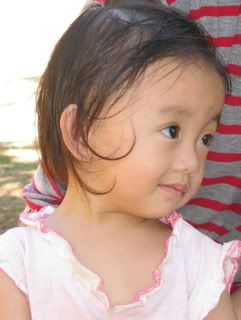
What will life be like for this Ifugao child?

Everyday, this child will wake to cheerful birdsongs and glorious sunrises. At night, she will be lulled to sleep by cool mountain breezes and the rhythmic calls of the crickets.

In time, she will learn the ways of her elders, and wear the colors of her tribe with pride. She will walk with the grace and dignity of her people, sure footed on even the steepest and most winding mountain trails. She will learn to work closely with Nature, knowing when the grains of rice will be ready for harvest, relying on the sun and the stars for the time, and the clouds for the weather.

And yet, this child will grow up differently.

As the times change, so will her future.

Another path is opening up to children like her. She will have more opportunities than those before her. The world will be at her feet.

She will have the best of both
tradition and modernity. She will retain the wisdom of her people, yet learn to harness technology for her needs.

She will stand tall beside people of other cultures, sure of her own identity. She will defend her rights -- as a woman, as an Ifugao, and as a person, above all -- and stand up for the rights of others.

Her spirit will soar, free and unfettered, even as she stays grounded in her reality. She will live with purpose, claiming all that is hers, and giving back all that she can.

With the grace of God, the love and support of her family, the blessings of Nature, and the benefit of a good education, this child will be all she can be.

26 April 2008

electricity in pula: good or bad?

Sitio Pula in the mountains of Asipulo, Ifugao*, which has gone without electricity for years, will reportedly have electricity in a few months.

The news has been met with different reactions. There is anticipation, if not relief, and maybe even eagerness from the residents. This opens up a whole new world for them -- of lights, more appliances, and radio and television programs. Already, one of the women we spoke with is certain that early bedtimes will become a thing of the past for her family, as they will most likely spend their nights watching TV.

On the other side of the spectrum, those who have visited or lived in Pula think that electricity may not necessarily be a good thing for the community.

"It will take away some of the charm," a volunteer said.

"You'll see the effects of electricity -- good and bad. I guarantee it," said another.

Now no one ever talks about the dangers of owning and running electrical lights, refrigerators, or even carpentry equipment. So quite obviously, the concern stems from the perceived negative effects of television and radio on the quiet little community.

media consumption
According to the National Statistics Office 2003 Functional Literacy, Education and Mass Media Survey (FLEMMS), the Cordillera Administrative Region (CAR), of which Ifugao Province is a part, has a functional literacy rate (able to read, write, compute, and comprehend) of 85.4%. CAR also has a high proportion of population vis-a-vis college education, second only to the National Capital Region (NCR).

Despite the encouraging figures, Pula is not teeming with newspapers and magazines; the nearest place to buy a newspaper is the capital town of Lagawe or even Kiangan, both about an hour away. In the 2003 FLEMMS, CAR showed one of the lowest rates of frequency of newspaper reading. Only 51.1% of the population in CAR relied on newspapers for knowledge and information. Radio was the most popular medium at 69.9% -- the highest number of radio listeners anywhere in the country -- while television registered only 53.3% -- not surprisingly, the lowest.

If the literacy rate in CAR is so high, why are the people listening to radio and watching TV more than reading newspapers? Their media preference might be a result of media infrastructure more than anything. Limited accessibility -- especially of Asipulo -- makes newspaper delivery difficult. On the other hand, the region as a whole has the advantage of geographic height, making it able to receive radio signals clearly.

an electrified pula
With electricity, the stillness that envelopes Pula will most likely be punctured by blaring stereo, radio, and TV sets.

Media exposure will undoubtedly continue to be heavily slanted towards radio and TV. This means faster availability and more effective delivery of news and information, which are so important to remote communities.

But -- and especially for TV -- this also means exposure to imported telenovelas, noontime variety shows, showbiz gossip, and programs with violence and sex.

These programs do nothing to support the Ifugao way of life or reinforce traditional values and ideals. In fact, it would be accurate to say that, with media's tendency to be Manila-centric, the Ifugao are underrepresented in TV and radio.

Would this be the end of a way of life? Only the people of Pula can say.

Without electricity, Pula has stayed disconnected from the rest of the country for years. It has kept their way of life intact, and their culture pure. But no one has the right to impose that this community community without electricity and its conveniences forever.

Exposure to TV and even radio programs may very well be an imposition of non-Ifugao culture on Pula. But for Pula residents, having electricity means being connected through TV and radio to life outside Asipulo and Ifugao. Good or bad, it is something that can't be avoided.

All we can do is hope that Ifugao culture and traditions are strong enough to withstand the introduction and intrusion of media and Manila-centric culture.

* I first wrote about Asipulo, Ifugao here.

16 April 2008

a national identity

In this age of globalization and the resulting homogenization of culture, does a Filipino identity stand any chance of surviving and prospering? Even without external influences, are our lifeways too diverse, the differences too pronounced, to produce a unified culture?

Section 3 of Republic Act 7356 discusses national identity this way:

Culture reflects and shapes values and beliefs and emulates the aspirations of the people’s cultural wisdom, thereby defining a people’s national identity. A Filipino national culture that mirrors Philippine economic, social, and political life shall be evolved, promoted and conserved.


Republic Act 7356, also known as "The Law Creating the National Commission for Culture and the Arts," defines culture as "a human right" in Section 2, as follows:

Culture is a manifestation of the freedom of belief and of expression, and is a human right to be accorded due respect and allowed to flourish.


Is it too naive or pretentious to think that the culture of the lowlands is as important as that of the seaside or the mountains? In Manila, a veritable melting pot, culture seems to be absent -- but this absence, of course, is in itself a culture. The farther away from Manila, the more evident the culture, it seems. Can one residing in a remote mountain barrio really embrace the culture of another on the opposite side of the country as being "Filipino?"

It is no big surprise that those living outside Manila strive to preserve their way of life. Take Filipino communities in other countries, for example. They seem more bent on celebrating, if not preserving, their Filipino-ness than the average Manileño.

Section 7 of the same law emphasizes the importance of preserving Filipino heritage:

It is the duty of every citizen to preserve and conserve the Filipino historical and cultural heritage and resources.


The reality is, no one can claim a monopoly on being Filipino or on living a Filipino life. Being Filipino is not just one particular characteristic or set or characteristics. Nor is it one dialect, one dress, one dish. One's duty to preserve and conserve is, simply, one's duty to be a Filipino.

09 April 2008

for whom?

When people hear the word "culture," they often think of expensive antiques, classical paintings and sculptures, fine dining, orchestras playing cerebral music, or high-society, black-tie events.

Such concepts, though not entirely unfounded, couldn't be more wrong.

Culture, as defined in the 1982 Mexico City Declaration on Cultural Policies, and approved by members of the United Nations Educational, Cultural and Scientific Organization (UNESCO) is:

...the whole complex of distinctive spiritual, material, intellectual and emotional features that characterize a society or social group. It includes not only the arts and letters, but also modes of life, the fundamental rights of the human being, value systems, traditions and beliefs.

This definition tells us that culture is simply how we live in a given time and place.

The Declaration goes on to affirm that:

...it is culture that gives man the ability to reflect upon himself. It is culture that makes us specifically
human, rational beings, endowed with a critical judgement and a sense of moral commitment. It is
through culture that we discern values and make choices. It is through culture that man expresses
himself, becomes aware of himself, recognizes his incompleteness, questions his own achievements,
seeks untiringly for new meanings and creates works through which he transcends his limitations.

The document lists more than 50 principles on culture and how it relates to development, democracy, education, communication, international cooperation, and peace.

Culture is therefore not limited in scope and object. It is as much a part of the life of the museum goer as it is the factory worker; the schoolboy and the matron; the businessman and the housewife; the call center agent and the market vendor.

It is for everyone.

15 March 2008

media as cultural workers

My previous post quoted Felice Prudente Sta. Maria's take on media organizations and practitioners as cultural workers.

The idea of media as contributors to culture should be nothing new to those of us who believe that the media do not act as mere documenters or recorders, but as active participants in the life of a nation.

Broadsheets, tabloids, magazines, radio, TV, the Internet -- all reflect current culture. More importantly, however, they highlight aspects of a way of life that their audience can relate to or otherwise react to. They may also -- knowingly or unknowingly -- set trends, or act as channels for these trends, in thought, behavior, speech, and fashion.

Take any newspaper. The different sections reflect what is current -- what is worth knowing -- in that particular aspect of our lives. As both storehouse and channel of information, the newspaper's success depends on how complete the information is, and how accurately it conveys it. But as the nature of news media goes, the newspaper must accomplish that work today. Tomorrow is another day, with new demands for completeness and accuracy.

The relevance and effectiveness of our media as cultural agents also lies in how effective they are as communicators, if not creators, of our common memories and aspirations. That is, the different media mirror not only the present, but also the past and the future. These memories and aspirations -- whether good or bad -- form part of our culture.

How a newspaper covers an event is the present. But how it celebrates or commemorates that same event years later -- such as its specials on the 1986 Edsa Revolution -- rekindles our collective memories as a nation. In the same way, how it looks ahead -- by reporting new developments or infrastructure projects, for example -- gives hope.

Media tell stories and paint pictures of our lives, of our society, of our nation -- and these become rooted in our culture. The telling of these stories and the painting of these pictures must be done responsibly, ethically, and with the welfare of the audience at heart. For the workings of media -- whether good or bad -- also form a culture of its own, which become part of the larger culture of our nation.

11 March 2008

media and culture

From A Cultural Worker's First Manual: Essays in Appreciating the Everyday, by Felice Prudente Sta. Maria:

Are those in media and education automatically cultural workers?

Whether they know it or not, all companies and institutions involved in media and education provide tools for cultural education, cultural information and cultural attitude formation. Unfortunately, not everyone in these fields accepts responsibility for cultural development. Cultural workers within the fields are those who promote a positive attitude for culture, preferably knowing it.

18 January 2008

fr. honti's 'pananagutan'

"Walang sinuman ang nabubuhay para sa sarili lamang, walang sinuman ang namamatay para sa sarili lamang (No one lives for himself alone, no one dies for himself alone)."

These simple words, plus an equally simple melody, make up the song Pananagutan. I remember learning this and other Catholic Mass songs as a second grader in a school run by nuns. The songs were all very easy to learn, and very "hummable," especially for me and my classmates. At the time, of course, I had no idea that the songs were a result of Vatican II -- and that they in turn would inspire other composers like Fr. Manoling Francisco, SJ, known for Hindi Kita Malilimutan (I will Never Forget You) and Tanging Yaman (One Treasure), and Fr. Arnel Aquino, SJ, of the Lauds series of CDs and tapes.

Neither did I know that I would one day get to meet the man who composed Pananagutan and the first Filipino mass songs -- Fr. Eduardo Hontiveros, SJ, better known as Fr. Honti. I had the opportunity to work with him for his CD entitled "Pananagutan" -- a tribute to him by his younger Jesuit brothers in the music ministry, known collectively as Himig Heswita. By then, he had had a couple of strokes or maybe more. He kept his arm at his side, his hand in a fist.

He could hardly speak but he tried to communicate in other ways. When asked to describe his songs, he bent over and laid his hand, palm down, at knee-level. It was a simple gesture, but it said a lot. He composed simple songs so that the common man, the masa -- anybody -- could sing them, and not just the trained singer or church choir member. In a Catholic world experiencing change after Vatican II, and striving to remain relevant, Fr. Honti was part of that change and part of that relevance. His songs were his pananagutan (responsibility) to all of us as both priest and composer.

Fr. Honti passed away a few days ago. But his songs have made their mark in the Philippine Catholic community. He has helped mold a generation of Filipino liturgical music composers, not to mention a Filipino mass culture. From the humblest chapel to the grandest cathedral, his songs have taken flight. They may not be as well known now as the newer mass songs, but he was the composer who started it all. His legacy lives on. Because of this, Fr. Honti will be remembered as "the father of Philippine liturgical music."