Showing posts with label philippines. Show all posts

18 February 2010

why not?: notes on tedx fort bonifacio

Yesterday's TEDx at Fort Bonifacio was, in keeping with TED tradition, a celebration of ideas. Not of the abstract kind, but of the practical kind. Ideas that inspire, challenge, and make one think.

First off, Ana Arce posed a challenge: make the world a little more Deaf-(with a capital "D" as opposed to "deaf") friendly. Have closed captioning and subtitles in movies. Or better yet, have sign language interpreters. For more about Ana's talk, read this.

Dr. Lourdes Cruz, who has worked extensively with the Ayta community in Morong, Bataan, presented the 4-helix model for S&T-based economic development. It's a mouthful, but it basically means giving the community a say in their development. It's a doable alternative to the usual development model, which relies on a 3-way interface between government, the academe, and business.

The inventions of the prolific Dr. David Manalo were actually very simple solutions to common and simple problems. As he said in this talk, "Why complicate the solution when the problem is simple?" His inventions had been awarded grants from the World Bank, no less. An audience favorite was the carabao decoy: kept outside the house, mosquitoes are supposed to flock to it, effectively sparing the people inside the house from mosquito bites. A simple solution, indeed -- but no awards or grants for that one.

Young photojournalist VJ Villafranca showed the audience a different way of seeing the world -- through the lens of a digital camera. From this vantage point, he explored the grit and grime of BASECO, an urban poor community in Manila. Each photo is a story in black and white, framed in stark contrast and harsh reality.

The husband-and-wife team of Drs. Chris and Marivic Bernido ended TEDx with a presentation on the sorry state of science education in the country -- and what they have done to turn it around. The figures are certainly impressive: 1% of high school seniors performing excellently in the sciences, and higher percentages getting average and above-average scores. At an estimated 700,000 high school seniors, 1% is 7,000 students. Wow.

TEDx organizer Gene Battung introduces the next speaker while Veronica Perez, dean of the De La Salle-College of Saint Benilde School of Deaf Education and Applied Studies, signs for the Deaf community.

In the end, what defined my TEDx experience was the fact that the ideas presented in the talks entered not only the broad realm of possibility, but more importantly, of doability.

So why not have more sign language interpreters? Why not involve communities in rural development? Why not use water to generate electricity for communities in the mountains? Why not use photos to tell stories and document life? Why not improve students' performance in the sciences? It's possible after all. So why not?

+++

I'm a TED fan, so it was only natural that, when I heard about TEDx happening at the Fort, I wanted to go.

But just to be clear, this wasn't the first TEDx talk in Manila. And hopefully not the last.

16 October 2009

vote for efren peñaflorida


If I could choose a beat, good news would be it -- stories about people like Efren Peñaflorida, Jr., people who make a difference.

More than 10 years ago, Peñaflorida and his friends founded an organization called Dynamic Teen Company, which has taken great strides in helping less fortunate children. He and his friends were in high school at the time. Since then, this young man has worked untiringly for the children under his organization's care.

Vote for Peñaflorida as CNN Hero of the Year.

To learn more, click here or watch the video below.


30 September 2009

an "ondoy" survival story

What makes survivors out of ordinary people? Is it luck? Being at the right place at the right time? Will and determination? The Forces That Be?

+++

I was waiting in line at the supermarket the other day and a lady at the other counter was telling the guy beside her the story of how a child miraculously survived the floods caused by tropical storm "Ondoy" while its mother, beside her, perished. "For some, it was their time -- but not for this child," I heard the lady saying in Pilipino.

Doubtless, everyone has a story to tell about "Ondoy," whether it's his/her own or someone else's, or something heard or witnessed. These stories will be told over and over to anyone who will care to listen, passed on to those who were not there, and remembered for the lessons they contain. For these are survival stories -- stories that inspire us, move us, and give us hope; stories that strengthen us and validate who we are and more importantly, who we can be in the face of even the most devastating appearances.

+++

The following was part of an email written by Nadj B., an underwater hockey player and triathlete. With her permission, I am posting it here as a first-person account of the floods caused by "Ondoy." Like thousands of Filipinos living in Marikina, Cainta, and other parts of Metro Manila hardest hit by the storm, Nadj and Chari O., also an underwater hockey player and triathlete, had to climb onto roofs and wait until either the waters subsided or help came.

This is their story.

--------------------------------------------------

I was having lunch with Chari in her house when it struck. We were supposed to ride that morning with FF in Alabang and/or do endurance training for underwater hockey that afternoon. All of which thankfully didn't push through, else her elderly parents would've been alone in the house with one frightened helper and five terrified dogs -- three of which are now missing.

I don't even know where to begin telling the story. Pretty much how we all felt when we went back to the house and saw the ruin. The floor was covered in foot-deep mud, the ceiling looked like it was going to fall any minute; heavy cabinets, pots and pans, electronic system, tables, sofas, beds... eveything was either floating or just on top one another stuck in mud. There was a dining chair on top of their gate, a barking dog atop their perimeter wall, cars on top of each other outside. You've seen the news. But it's much much different when you're actually there and seeing all the shambles; much much different when you actually have to wade through rising flood in grounded water (most terrifiying for me); much much different when it's your story to tell. Chari and I cut our feet in attempts to reach loved ones who were yelling for help in other parts of the house; Chari cut her wrist when she broke the glass door in our desperate attempt to save all her dear dogs. Her parents were wet and shivering on top of the roof. Everything played out like it was in the movies only this time it was (really) real.

On the rooftop, you could see other people madly scrambling to get to the top. People hanging on to branches of trees yelling for help; a lola (grandmother) who was hanging on for dear life while she literally hung like a butiki (gecko) on the bottom side of their rooftop. We helped everyone up. We helped comfort those who needed comforting. Sometimes, a gentle talk and just a little encouragement were all they needed to bravely get from one point to another. We helped people cross roofs and make paths where people rapelled and pets were guided from one roof to the balcony of another. We managed to reach the 3rd floor of a neighbor's house where it was safe and dry.

There, the experience was altogether surrreal. Everyone had a story to tell. A woman was crying her eyes out as she told the stoy of all her dogs being trapped in a closed room. A woman from the other roof was having a seizure. After everything had somehow settled, Chari and I tended to our wounds. Luckily, we were able to ask for some betadine and cotton before the 2nd floor rooms became inaccessible. The adrenaline was going down and we were both starting to feel the pain. Chari's cuts on her right foot and right hand were all much much deeper than mine. We wrapped our bandaged wounds in torn grocery platic bags just to keep them dry.

We were dry, safe; we ate hot food, and we had toilet and water. Other people on other roofs were not as lucky as they sat wet and cold huddled under flimsy umbrellas. They stayed that way for more than 12 hours. I couldn't help but feel guilty for all the "comfort" we had. If only there was something more we could do other than try to survive the night.

At around 10am we were walking through the filthiest water we've ever been in: dead dogs, dead rodents, dead cats, garbage, feces... it was the longest, dreariest 500m. But again, we were still lucky. Other people were dead in other areas.

Afterward we proceeded to the hospital to get tetanus shots. The doctors didn't stitch Chari as her wounds were already more than 24 hours.

Thank you to all our friends who kept us in their prayers. I'm sure that it was your loving and sincere thoughts that kept us safe and serendipitously sent RY our way yesterday.

More stories to tell but we'll probably just tell you in person.

28 September 2009

help for victims of typhoon ondoy ('ketsana')


posted on YouTube by user mcfly1151985

For donations and/or inquiries:
  1. ABS-CBN Sagip Kapamilya Hotline: +632 4132667 / +632 4160387 / +632 4163641
  2. Bureau of Fire Protection Region III (Central Luzon) Hotline: +6345 9634376)
  3. Department of Social Welfare and Development (DSWD): +632 9517119 / +63918 4217890
  4. GMA Kapuso Foundation: +632 9289351 / +632 9284299
  5. Marikina City Rescue: +632 6462436 / +632 6462423 / +63920 9072902
  6. Metro Manila Development Authority (MMDA): 136 / 16220 / 16211 / +63917 5592884
  7. National Capital Regional Police Office (NCRPO) Hotline: +632 8333203 / +632 8383354
  8. National Disaster Coordinating Council (NDCC) : +632 9125668 / +632 9111406 / +632 9115061 / +632 9122665
  9. NDCC Help hotlines: +632 7342118 / +632 7342120 / ndcchelpdesk@gmail.com
  10. Pasig Rescue Emergency Number: +632 6310099
  11. Philippine Coast Guard: +632 5276136
  12. Philippine National Red Cross: 143 / +632 5270000
  13. Philippine National Red Cross Rizal Chapter operations center hotline: +632 6350922 / +632 6347824
  14. Quezon City Rescue: 161
  15. San Juan City Hall Command Post: +632 4681697

posted on YouTube by user bongvideos


08 April 2009

notes on cotabato city

Fact: Cotabato City is not located in North nor in South Cotabato. It used to be the capital of Cotabato Province, which used to be the largest province in the entire country. The province has since been divided into North Cotabato, South Cotabato, Maguindanao, and Sultan Kudarat. 

Fact: Cotabato City is found within the borders of the province of Maguindanao, but is not considered part of that province. (It used to be, though.)

Fact: Cotabato City is "the regional center of the Autonomous Region in Muslim Mindanao," but it is not part of the ARMM. It is actually part of Region XII or SOCCSKARGEN.

+++

The members of the Cotabato City Tourism Council were very accommodating and patient in answering all our questions. More than this, one could sense their genuine pride in sharing with us various facets of their collective story as Cotabateños -- from the Palasyo ng Masa (People's Palace) to the etymology of the name "Cotabato," from the uses of inaul to the "lost wax" brass making process, from the finer points of eating durian to the hows of preparing agar-agar (seaweed) and the different delicacies of the area.  

It was an experience I don't think I'll ever forget, and I do hope to return there someday.

27 June 2007

pinoys on the web

My "Proudly Pinoy Blog" badge (to the right of the screen) will soon get a replacement.

A competition to design a "Proudly Pinoy" logo to be used without charge on Filipino-owned web sites and blogs was recently launched.

The organizers of this competition, which ends on 11 July, no doubt realize the importance of establishing a distinct Pinoy identity on the web.

Displaying this badge on your site or blog is the virtual equivalent of planting the country's flag atop a mountain. But more than being a symbol of Pinoy pride, the badge identifies you as a member of the community of online Filipinos.

How many Filipinos own web sites? How many are bloggers? The number can't be that big, considering that as of last year, there were only a little over seven million Internet users in the Philippines. That's about nine percent of our total population.

But consider this: for such a small nation, we are on the Internet map. Pinoys are on the Internet and not just as consumers, but more importantly, as producers -- whether as web designers outsourced by foreign companies, or as bloggers whose hits come from all over the world.

So a "Proudly Pinoy" badge makes sense.

The winning designer will get P10,000 (a little more than $200). As of this post, 71 entries have been submitted and can be seen on the site.

22 June 2007

she loves me, she loves me not...

As I write this, Asia News Network associate editor and former Bandillo ng Palawan editor-in-chief Jofelle Tesorio is free again.

She was released after some 10 hours in prison. Why was she even there, to begin with, considering that she had already posted bail?

love-hate relationship
This happened just a day after the newspaper headlines screamed that President Gloria Macapagal Arroyo was seeking the media's help in the last leg of her presidency. It makes one wonder about her relationship with the Philippine press -- a love-hate relationship, to my mind.

I still remember that infamous press conference that members of the Foreign Correspondents' Association of the Philippines (FOCAP) were banned from attending. FOCAP members observed that not even the late President Marcos did such a thing.

Then came Proclamation 1017, which placed the country under a state of emergency. Though it lasted for just a week, it was enough to create a chilling effect. The office of The Daily Tribune was raided, and a military presence was established in other media organizations.

change of heart
And of course who can forget the First Gentleman's libel suits against some 40 journalists last year? These were all magnanimously dropped after Mr. Arroyo's successful heart surgery in April this year. Looks like he had a sudden change of heart (sorry, I couldn't resist the pun).

But he wasn't the only one. On 15 June, the Philippine Daily Inquirer carried a story about the President promising "to end the killing of journalists and protect them from libel suits and arbitrary arrest." She also called upon all journalists to join hands with her administration "in mutual trust and common purpose so that all the violence will be stopped."

Since Ms. Arroyo assumed office in 2001, 51 journalists have been killed.

ask not what the media can do...
This is undoubtedly a president who knows what the media can do for her and her administration.

She is aware that the media can play a huge role in the downfall of a president, as it did in the case of her predecessor. She knows how relentlessly the press can pursue a story to uncover the truth, as what happened in the "Hello, Garci" affair. And she feels the watchful gaze of international media and human rights organization who are determined to make her administration accountable for infringements on the freedom of the press.

Is she now eager to show what she can do for the media?

relief
The Philippine press heaved a collective sigh of relief as Jofelle walked out of detention in Quezon City. Whether this relief is temporary and short-lived will depend on whether the President makes good her promise to put a stop to the killing, suing, and arresting of journalists.

Read more about Jofelle's arrest here.

20 June 2007

the bugo-bugo in the senado

Along with Sen. Rodolfo Biazon, there are three newly elected retired or otherwise former military officers and graduates of the Philippine Military Academy in our Senate: Panfilo Lacson and Gregorio Honasan (PMA '71) and Antonio Trillanes (PMA '95).

I was able to catch the first part of the recent edition of ANC's "Strictly Politics" with all of these cavaliers (as PMA'ers are called) as guests, except for Trillanes. The fact that there are four of them in the Senate has become a cause for recent concern and discomfort. The presence of former military officers in the Cabinet and other areas of public service, and now in the Senate -- what is this, some kind of club? Unfortunately, the proverbial fuel was added to the fire with the statement of one of them, editorialized in the Philippine Daily Inquirer, a few days ago, that essentially -- yes, there is some sort of club.

My interest is the commonality among the four. What binds them together is the PMA experience -- the discipline, the values, and the lessons learned within the walls of Fort del Pilar as well as out on the field. It is not necessarily the same experience, but the bond exists, forged by a code of conduct we can only wonder about. Yet, is this bond enough for them not to go head to head over matters that may arise in the future?

Belongingness, as I mentioned in my previous post, stems from such commonalities. They all are PMA graduates, and so we can assume that to some extent, they shared one community. But years after the PMA, and with years apart among them (except for Honasan and Lacson, who were classmates) -- were their communities still the same? Was Biazon's cadet life the same or at least comparable to Trillanes'? What about Lacson and Honasan, mistahs though they are, did they experience the same military experiences after leaving the PMA?

I wanted to see where the discussion was going, but didn't have much time to watch. I stayed long enough to hear Sen. Honasan say that in the Senate, it's the national agenda they are pushing, not the agenda of the bugo-bugo -- a term of endearment used at first for plebes, and later, for fellow PMA'ers. Can we trust their definitions of the national agenda, considering the very different personalities and alignments of the four? All of them were involved in their own different interpretations of service to the nation at some point in their careers -- whether mutiny, coup d'etat, or defense.

Commonalities or not, their first duty -- as well as that of the other senators, for that matter -- is in the exercise of their responsibilities as elected senators. It is to the public, the people that elected them, that they must prove themselves and be accountable. Not to the PMA, as institution and community, and certainly not to the bugo-bugo.

12 June 2007

mabuhay!


I'm posting this video of Lupang Hinirang as a reminder that Philippine society is far from perfect.

Not all our presidents were great. Not all our heroes were selfless. Not all our athletes bring home the gold. Not all our public servants are noble. Not all our families are happy and intact. And not all our babies are healthy and well cared for.

It will take some time before we are rid of all our ills and become the people we want to be.

In the meantime, we are free. And while we are free, there is hope.

Mabuhay!

07 June 2007

a real community

In his book Imagined Communities: Reflections on the Origin and Spread of Nationalism, anthropologist Benedict Anderson defines a nation as "an imagined political community":

It is imagined because the members of even the smallest nation will never know most of their fellow-members, meet them, or even hear of them, yet in the minds of each lives the image of their communion.... (A)ll communities larger than primordial villages of face-to-face contact (and perhaps even these) are imagined. Communities are to be distinguished, not by their falsity/genuineness, but by the style in which they are imagined....

The nation is imagined as limited because even the largest of them encompassing perhaps a billion living human beings, has finite, if elastic boundaries, beyond which lie other nations. No nation imagines itself coterminous with mankind. The most messianic nationalists do not dream of a day when all the members of the human race will join their nation in the way that it was possible, in certain epochs, for, say, Christians to dream of a wholly Christian planet....

Finally, it is imagined as a community, because, regardless of the actual inequality and exploitation that may prevail in each, the nation is always conceived as a deep, horizontal comradeship. Ultimately it is this fraternity that makes it possible, over the past two centuries, for so many millions of people, not so much to kill, as willingly to die for such limited imaginings.


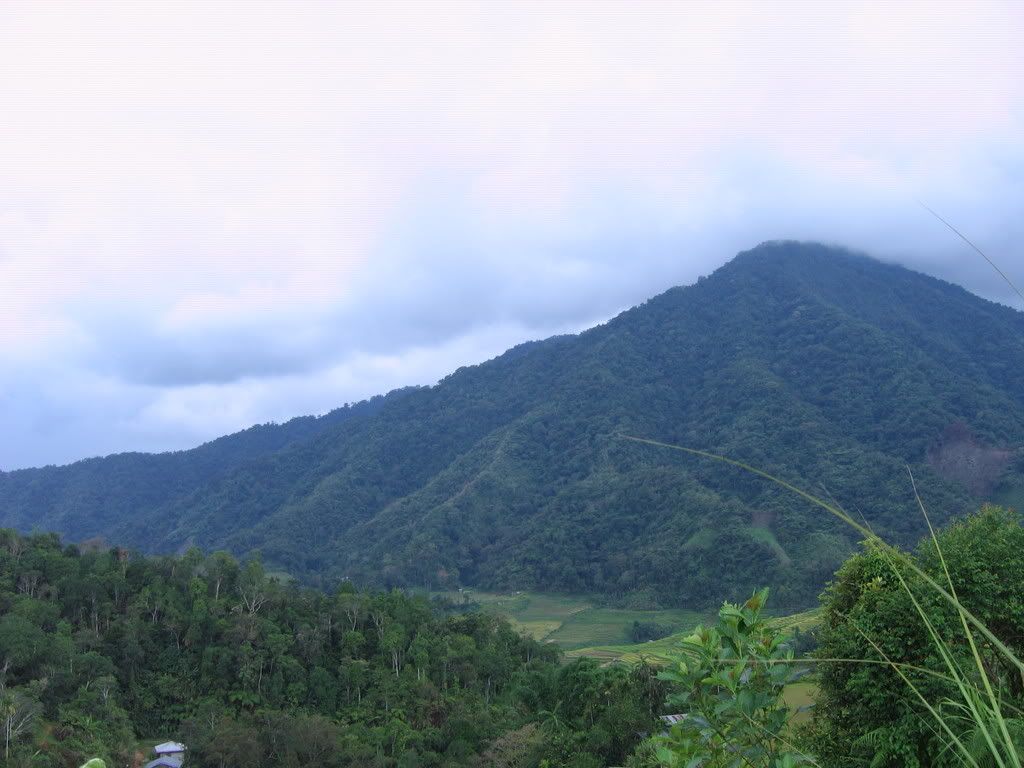
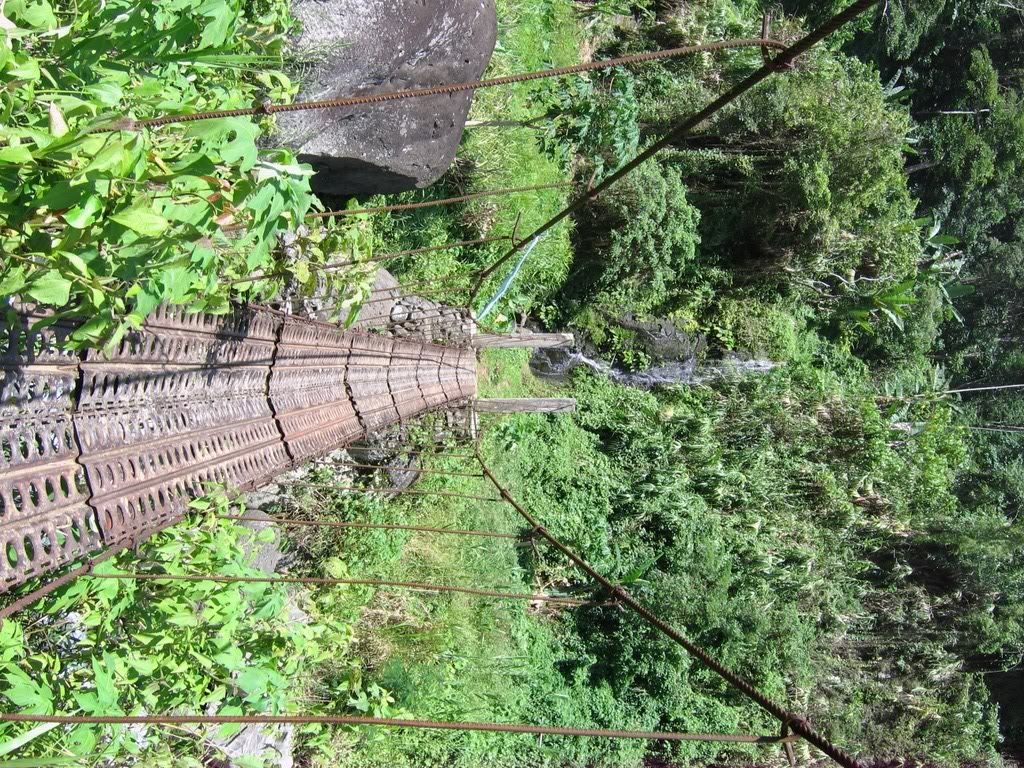
I remembered this a few days ago as I looked out over the mountains of Ifugao Province, en route by tricycle to the municipality of Asipulo from Kiangan. The trip was nearly an hour over roads that were thankfully concrete in some places, rough and bumpy in most, and generally winding up and down through some of the prettiest views I had ever seen in my life.

The farmers who hosted our stay in Sitio Pula and the locals who guided us through the thick mountain forest -- what did I have in common with them? Not geographic location, nor way of life, nor language. The place I've called home for most of my life seems a world away from here; the dialect I speak (Tagalog) is foreign to these people. The mountain trail that took me a painful hour to traverse (and not without their help and patience, I might add), they breeze through in half or even a quarter of that time. Indeed, we measure time differently -- they, by seasons of planting and harvest, and I, by semesters and projects.

They would probably never understand what I do -- how I can spend up to hours in front of a computer in my little room, my dependence on an unseen yet powerful thing called the Internet that travels through cables and allows me to reach out to other members of a community not only imagined but also perhaps previously unheard of. In the same way, try as I might, I would probably never fully grasp what life on a mountain is really like -- how to read the signs of the sky and the earth, how to live in harmony with Nature and with other beings who make the mountain their home.

But in our minds, did "the image of our communion" already exist even before we met? Did we each imagine that hundreds and thousands of kilometers away from our homes were people who led lives the polar opposite of our own? They, Ifugao, and I, Manileña -- did we see ourselves as actually sharing a nationality, a Filipino-ness? Did the fact that we are both Filipino -- a term that signifies membership in this imagined community -- compel us to appreciate each other before we had even met? And having met, did we find that we shared more than what we had ever imagined?

In Asipulo, I was in a totally different place from where I live, in a situation I would not quite have imagined myself to be, amid people who were strangers to me. Yet, I felt I belonged, perhaps because this place was part of my nation -- imagined or not -- but more importantly, because the people recognized in me a co-member in a very real community called mankind.

And recognizing me as such, the people of Asipulo reached out to me, as I did to them, shared their food and their homes, offered me a glimpse into their lives -- and simply made me feel welcome.