Showing posts with label media. Show all posts

17 August 2008

the trend towards entertainment news

An interesting story on the Newsbreak website by Aries Rufo, entitled "Changing media landscape sidelines labor stories" points to a growing trend: "less and less stories about work" and more and more stories on entertainment.

Quoting National Federation Italian Press President Roberto Natale, the story says that one of the causes is of this phenomenon is journalists and the owners of media organizations abdicating their "social role."

BBC's Steve Schifferes says the rise of the 24-hour news service also has something to do with it, as it lends itself to more "superficial" content.

The irony should not be lost on anyone. What Natale and Schifferes are saying here is that the culprits are 1) the gatekeepers themselves -- that is, those who determine what news is -- and 2) the media through which the news is transmitted.

Is this an international phenomenon? Even without hard figures, one would agree that there seems to be more showbiz news on local TV and print media than, say, even 5 years ago.

This might not necessarily mean that media organizations and practitioners are going soft. In the spirit of fairness, it would help to remember that the news industry does not exist in a vacuum. There is the audience, with its preferences for TV (and perhaps increasingly, the Internet) and for light news are a key factor here.

And then there is the availability of all sorts of information. What previously had to be dug up, researched, and reported by a resourceful and hardworking journalist can now be easily accessed online. With the gatekeeper function now in the hands of anyone with a computer and Internet connection, any information is now being passed off as news.

For now, it's hard to say where this is going, or what kind of news coverage we will have 5 years from now. It's a trend, after all.

Let's hope that's all it is -- a trend.

17 July 2008

diverse and dynamic

The annual conference of the Asian Media Information and Communication Centre (AMIC), held at the Manila Hotel this year, was an eye opener.

The list of topics and names on the program was certainly exhaustive enough to overwhelm. But to actually be there and see researchers and practitioners sharing their experiences and talking about future directions made one feel how diverse and dynamic the region and the field are.

The session on alternative media was an interesting mix of old and new: Sanskrit writings and their relationship to journalism principles, and a survey of community-based approaches to broadcasting as practised by Church-owned radio stations in the Philippines on the one hand; and citizen journalism as practised by a news organization in Malaysia, and a uses and gratifications analysis of Facebook uses at the University of Singapore, on the other.

It was an interesting session, not only because the presentations were interesting in themselves, but also for the selection of these presentations under the classification of alternative media. Indeed, the term "alternative" is broad enough to apply to old and new -- the traditional and the cutting-edge -- as represented by these topics from the societies of India, the Philippines, Malaysia, and Singapore.

During the conference, AMIC launched six new publications, including the Asian Communication Handbook 2008, Media and Conflict Reporting in Asia, and Media and Development in Asia: Regional Perspectives.

03 June 2008

can the internet fill in the gaps?

I came across this talk by Alisa Miller on TED, entitled "Why we know less than ever about the world."

Miller, who heads Public Radio International, makes valid -- if not disturbing -- points about how the quality of news coverage in the US and on the Internet has dropped. So much so that today's young American knows more about Britney Spears and less about what's going on outside his country than his counterpart 20 years ago.

With much of international news dependent on coverage by US-owned networks, where does this leave the rest of us? Are non-Americans as much in the dark?

Can the Internet -- blogs and other alternative or indie news sites -- fill in the gaps in news coverage?

30 April 2008

what is news?


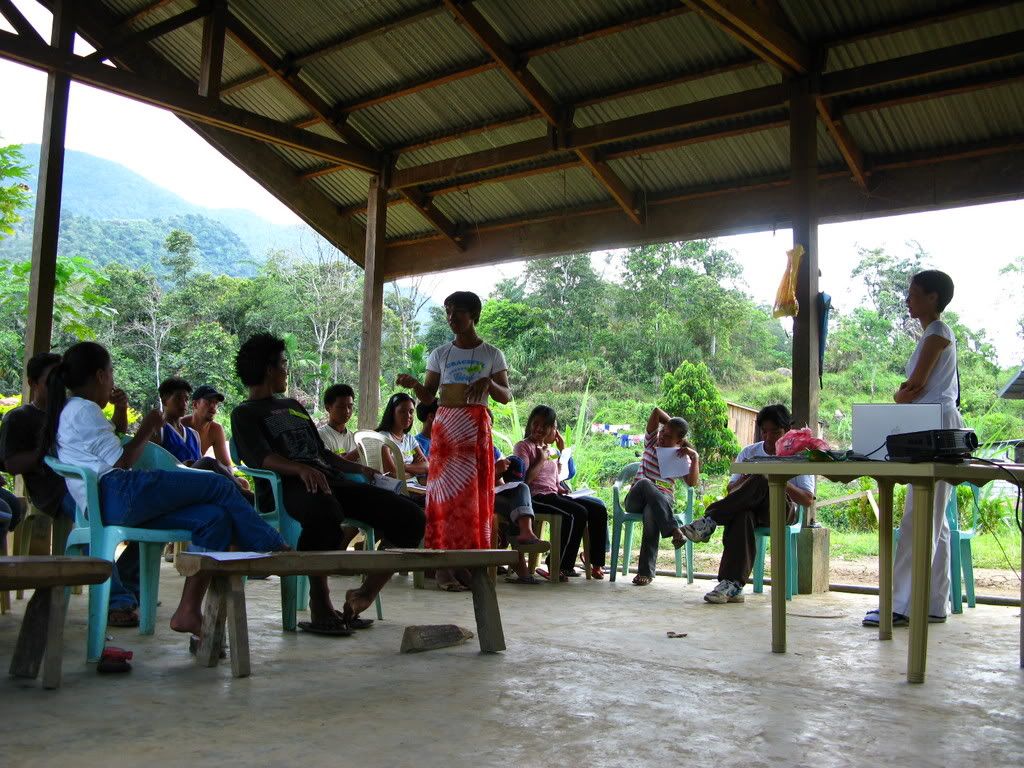
At a news writing workshop with the youth of Asipulo, Ifugao, we went through the preliminaries of defining the term "news."

Is news anything reported in the papers, on TV, or on the radio?

Is news anything that happens to a celebrity like Kris Aquino?

Could anything happening in their remote municipality be news?

The young people of Asipulo had a simple definition. To them, news is information that must be known and reported because it is important.

Given that they hadn't been taught the concept of news values before the workshop -- formally, at least -- the recognition of news as something that must be known (from the audience's perspective) and reported (from the journalist's perspective) is exactly what we were going for.

To them, the long lines to buy rice in Quezon City was news. The recent wedding of a foreigner slash community volunteer was news. The death of a community member would be news.

We talked about why some events would be considered news, and why some would not.

The difficulty in buying rice, for example, was of interest to them perhaps because it was an alien concept. As children of farmers, they could not imagine it ever happening in their locality.

They considered the wedding of the volunteer to be news because he was an important member of the community. The same was true of the death of a community member -- especially if s/he were an elder or a prominent figure.

One of the workshop participants related the concept of news to an advocacy: you report something because it is your advocacy. I must admit I didn't expect to hear this from them. Nevertheless, this is certainly true. Whether journalists acknowledge it or not, they are advocates of truth, democracy, development, justice, and peace.

Another thing that surprised me was when some of them asked about the killings or otherwise repression of journalists. This told me that they were somehow aware of the concept of freedom of expression and its importance.

The workshop was an enriching experience for me. I learned a lot through the perspective of an audience who are not media-savvy and who are in fact underrepresented in media.

I realized that young people -- in particular, this group in Asipulo, Ifugao -- have a lot to say, and that a newsletter such as the one they are planning to publish would indeed give them a voice.

And I remembered why and for whom we do what we do.

Thank you, Providential Youngsters Society!

26 April 2008

electricity in pula: good or bad?

Sitio Pula in the mountains of Asipulo, Ifugao*, which has gone without electricity for years, will reportedly have electricity in a few months.

The news has been met with different reactions. There is anticipation, if not relief, and maybe even eagerness from the residents. This opens up a whole new world for them -- of lights, more appliances, and radio and television programs. Already, one of the women we spoke with is certain that early bedtimes will become a thing of the past for her family, as they will most likely spend their nights watching TV.

On the other side of the spectrum, those who have visited or lived in Pula think that electricity may not necessarily be a good thing for the community.

"It will take away some of the charm," a volunteer said.

"You'll see the effects of electricity -- good and bad. I guarantee it," said another.

Now no one ever talks about the dangers of owning and running electrical lights, refrigerators, or even carpentry equipment. So quite obviously, the concern stems from the perceived negative effects of television and radio on the quiet little community.

media consumption
According to the National Statistics Office 2003 Functional Literacy, Education and Mass Media Survey (FLEMMS), the Cordillera Administrative Region (CAR), of which Ifugao Province is a part, has a functional literacy rate (able to read, write, compute, and comprehend) of 85.4%. CAR also has a high proportion of population vis-a-vis college education, second only to the National Capital Region (NCR).

Despite the encouraging figures, Pula is not teeming with newspapers and magazines; the nearest place to buy a newspaper is the capital town of Lagawe or even Kiangan, both about an hour away. In the 2003 FLEMMS, CAR showed one of the lowest rates of frequency of newspaper reading. Only 51.1% of the population in CAR relied on newspapers for knowledge and information. Radio was the most popular medium at 69.9% -- the highest number of radio listeners anywhere in the country -- while television registered only 53.3% -- not surprisingly, the lowest.

If the literacy rate in CAR is so high, why are the people listening to radio and watching TV more than reading newspapers? Their media preference might be a result of media infrastructure more than anything. Limited accessibility -- especially of Asipulo -- makes newspaper delivery difficult. On the other hand, the region as a whole has the advantage of geographic height, making it able to receive radio signals clearly.

an electrified pula
With electricity, the stillness that envelopes Pula will most likely be punctured by blaring stereo, radio, and TV sets.

Media exposure will undoubtedly continue to be heavily slanted towards radio and TV. This means faster availability and more effective delivery of news and information, which are so important to remote communities.

But -- and especially for TV -- this also means exposure to imported telenovelas, noontime variety shows, showbiz gossip, and programs with violence and sex.

These programs do nothing to support the Ifugao way of life or reinforce traditional values and ideals. In fact, it would be accurate to say that, with media's tendency to be Manila-centric, the Ifugao are underrepresented in TV and radio.

Would this be the end of a way of life? Only the people of Pula can say.

Without electricity, Pula has stayed disconnected from the rest of the country for years. It has kept their way of life intact, and their culture pure. But no one has the right to impose that this community community without electricity and its conveniences forever.

Exposure to TV and even radio programs may very well be an imposition of non-Ifugao culture on Pula. But for Pula residents, having electricity means being connected through TV and radio to life outside Asipulo and Ifugao. Good or bad, it is something that can't be avoided.

All we can do is hope that Ifugao culture and traditions are strong enough to withstand the introduction and intrusion of media and Manila-centric culture.

* I first wrote about Asipulo, Ifugao here.

15 March 2008

media as cultural workers

My previous post quoted Felice Prudente Sta. Maria's take on media organizations and practitioners as cultural workers.

The idea of media as contributors to culture should be nothing new to those of us who believe that the media do not act as mere documenters or recorders, but as active participants in the life of a nation.

Broadsheets, tabloids, magazines, radio, TV, the Internet -- all reflect current culture. More importantly, however, they highlight aspects of a way of life that their audience can relate to or otherwise react to. They may also -- knowingly or unknowingly -- set trends, or act as channels for these trends, in thought, behavior, speech, and fashion.

Take any newspaper. The different sections reflect what is current -- what is worth knowing -- in that particular aspect of our lives. As both storehouse and channel of information, the newspaper's success depends on how complete the information is, and how accurately it conveys it. But as the nature of news media goes, the newspaper must accomplish that work today. Tomorrow is another day, with new demands for completeness and accuracy.

The relevance and effectiveness of our media as cultural agents also lies in how effective they are as communicators, if not creators, of our common memories and aspirations. That is, the different media mirror not only the present, but also the past and the future. These memories and aspirations -- whether good or bad -- form part of our culture.

How a newspaper covers an event is the present. But how it celebrates or commemorates that same event years later -- such as its specials on the 1986 Edsa Revolution -- rekindles our collective memories as a nation. In the same way, how it looks ahead -- by reporting new developments or infrastructure projects, for example -- gives hope.

Media tell stories and paint pictures of our lives, of our society, of our nation -- and these become rooted in our culture. The telling of these stories and the painting of these pictures must be done responsibly, ethically, and with the welfare of the audience at heart. For the workings of media -- whether good or bad -- also form a culture of its own, which become part of the larger culture of our nation.

11 March 2008

media and culture

From A Cultural Worker's First Manual: Essays in Appreciating the Everyday, by Felice Prudente Sta. Maria:

Are those in media and education automatically cultural workers?

Whether they know it or not, all companies and institutions involved in media and education provide tools for cultural education, cultural information and cultural attitude formation. Unfortunately, not everyone in these fields accepts responsibility for cultural development. Cultural workers within the fields are those who promote a positive attitude for culture, preferably knowing it.