Showing posts with label democracy. Show all posts

14 September 2009

whose rights? whose wrongs?

The title of the Southeast Asian Press Alliance's (SEAPA) report says it all: Philippine Ombudsman tightens rules on release of statements of assets and liabilities of government officials.

With these rules, what is going to happen to the public's right to know?

Is the Statement of Assets, Liabilities, and Net Worth supposed to be confidential? The last time I checked it was a public document.

Are public officials supposed to be protected? From what, I wonder. And here we all thought they were supposed to be held accountable for their actions.

Kudos to Vera Files for their vigilance.

Read the Southeast Asian Press Alliance's report (SEAPA) here.

25 November 2008

online youth unite

It's about time young netizens of the world were recognized as a force to reckon with.

This article from inquirer.net strengthens the idea that today's online youth can do much, much more than IM and connect with their friends on Facebook or Myspace.

According to the article, the US State Department plans to tap online youth groups in the fight against terrorism and crime.

To get things started, 17 youth groups will come together on December 3 to 5 for a conference at the Columbia University Law School.

Although groups without an online presence will also participate in the conference, these plans demonstrate that having an online presence is an empowering force.

In many cases and for countless organizations and even individuals worldwide, it spells the difference between having a worthwhile cause and mobilizing people for that cause.

Read more about the US State Department's plans to empower online youth here.

15 November 2008

burmese blogger sentenced

It was a first for the Burmese blogosphere: on November 10, the military junta sentenced a blogger, Nay Phone Latt.

According to a report by Mizzima, the blogger, who was arrested earlier this year, was sentenced to more than 20 years. The bulk of this sentence was for violating the Electronics Act.

The 2007 Annual Worldwide Press Freedom Index of Reportiers sans frontieres (Reporters without Borders) ranked Burma 164th out of 168 countries for both 2006 and 2007.

Also notable in the 2007 index is the observation of "serious, repeated violations of the free flow of online news and information." RSF says that 64 people around the world have been sentenced for something they have posted on the Internet.

In Burma, though the number of blogs is still very limited -- perhaps only 200, by one Burmese national's estimate -- outside the country, there are more.

With the junta monitoring and restricting Internet usage in Burma, it is a wonder that bloggers like Nay Phone Latt are even able to maintain a blog. An Internet Law has been in place in the country from as early as 2000.

According to Burmese nationals, the government server bans even free email sites like Gmail, Yahoo, and Hotmail.

Click here for the full story on Nay Phone Latt.

22 June 2008

reflections after a workshop

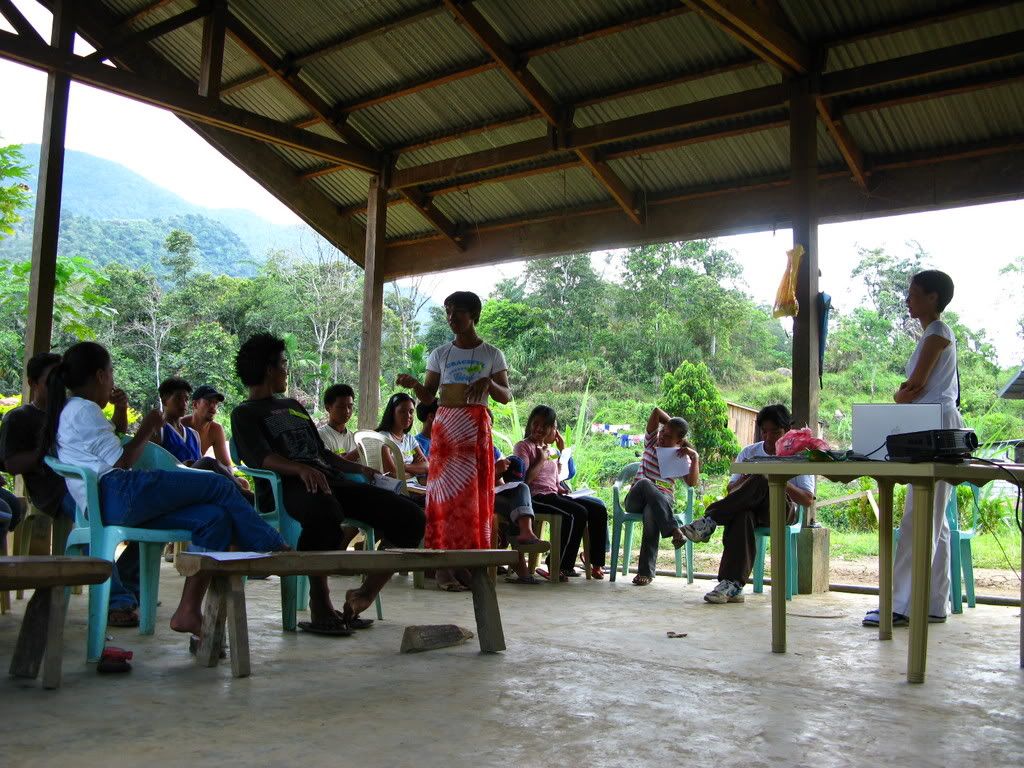
We recently had a news writing workshop with the members of the Providential Youngsters Society (PrYS)-Kiangan in Ifugao.

The young people of Kiangan, I discovered, are a lot more media-savvy than their counterparts from Asipulo -- a municipality where some barangays are not accessible except on foot and have no electricity.

Some participants attended the workshop with earphones glued to their ears.

After the workshop, some participants asked us if we had Friendster accounts.

How does their exposure to media affect them? How do they use it? Do they use it to their advantage? For research? For entertainment?

Do they feel empowered to use it to tell the world about their community? Or do they use it to get out of it?

If they could only feel empowered, think how much richer the national and even global dialogue would be. Citizen journalism is this dialogue, proof of empowerment, an alternative to the established media.

In the end, I believe that these young people can contribute. This is why we do these workshops: to help them contribute. A newsletter isn't just a newsletter -- it's citizen journalism.

Perhaps my hoping they'd be citizen journalists someday is too ambitious, but there are stories only they can write. There is knowledge only they can share. And there is a future only they can create.

----------------------

This photo shows PrYS organizer Gerald Puguon, Jr. accepting a book donation on behalf of PrYS. The books were given by the Konrad Adenauer Asian Center for Journalism (ACFJ) at the Ateneo de Manila University to support PrYS's efforts to publish a newsletter.

19 June 2008

lessons learned

I haven't been following the Ces Drilon kidnapping as much as I would have wanted to. So when I came across this story on inquirer.net, I begin to wish I had.

Here is an excerpt:

(PNP Director General Avelino) Razon said that if there was any lesson from the kidnapping, it was also to properly exercise press freedom.

"Ang aral po dito laging sinasabi hindi natin puwedeng i-exercise press freedom na malalagay ang [The lesson here is we can't exercise press freedom by putting] reporters or journalists in harm's way, na hawak ng terrorista or criminal elements," said Razon.


Was caution thrown to the winds in this case? Was there a lapse in judgment? Was there a violation of trust, an unreliable source or contact?

As I said, I wasn't able to follow the case, so these are sincere questions, not mere rhetoric. My point is to learn from this, as any media analyst or observer -- armchair, virtual, or real -- would want to. After all, we all have the benefit of 20/20 hindsight.

What Razon said is simply another way of saying that no story is worth a reporter's life. Even if you're not a conflict or war reporter or correspondent, you would know this by heart or at least would have heard this enough.

But this begs the question: "journalist par excellance" or not, why, oh, why would anyone not a war reporter be sent into a war or conflict zone?

No story is worth a person's life.

03 May 2008

the catholic church as media practitioner

A report posted yesterday on the CBCP News site urges Filipino Catholics to support the Church's media apostolate, as Catholics everywhere celebrate World Communications Day tomorrow.

I don't know how aware Filipino Catholics are about the media apostolate of the Church. In any case, the report caught my attention because it is related to my master's project.

media and vatican II
Even before the Vatican II conference, the Catholic Church had already recognized the importance of media in their mission. It was only during Vatican II, however, that they issued their first official document on the topic -- the Inter Mirifica.

The document introduced the term "social communication" -- a catchall for any form of interpersonal communication. This included media, literature, theater, film, dance, music, and the visual arts. The term is broad enough to include the Internet and even SMS.

A follow-up document called Communio et Progressio established the Church's media apostolate. It recommended that the Church set up media offices and assign priests, nuns, and lay workers to manage these offices.

Today, one will find a media office at almost every level of the Church hierarchy -- from the Vatican to the smallest local parish.

In the Philippines, there is the Catholic Bishops Conference of the Philippines (CBCP) Episcopal Commission for Social Communication and Media, the National Office of Mass Media, and media offices at the level of the archdiocese and diocese. Different congregations own and manage their own media arms. The secretary of the Federation of Asian Bishops Conferences Office of Social Communication (FABC-OSC) also holds office here.

why a media apostolate?
In the above Church documents, there is recognition that social communication -- including media -- is necessary as a means to evangelize.

Undoubtedly, the Catholic Church wields influence in Philippine society. It is active in the lives of most Filipinos, who are baptized, married, and buried in Catholic rites. Its presence is felt in even the smallest and remotest barrios, where parish priests are respected members of the community. Churches are crammed with faithful followers on at least two days of the year -- Easter Sunday and Christmas.

Considering the pervasiveness of the Catholic culture in our society, is a media apostolate still needed? On the other hand, are Church-owned or otherwise Catholic media effective in their mission of evangelizing or of deepening the faith of Filipino Catholics? Do Filipinos read Church-owned newspapers and publications, watch or listen to Catholic programs, or visit Church-run websites?

"a choice"
Bishop Bernardino Cortez, who heads the Episcopal Commission on Social Communication and Media, described Catholic media as "a choice" that allows us "to be strengthened in our faith" in confusing times.

After all is said and done, this is probably the best way to describe Catholic media: a choice. Such a choice would not be available in other countries, particularly those where freedom of expression is not guaranteed by the constitution. The presence of Church-owned media is, at the very least, an indication that we are still a democracy. We are still free -- free to worship as we please, free to choose what we read or watch or listen to, and free to decide for ourselves which course of action to take.

30 April 2008

what is news?


At a news writing workshop with the youth of Asipulo, Ifugao, we went through the preliminaries of defining the term "news."

Is news anything reported in the papers, on TV, or on the radio?

Is news anything that happens to a celebrity like Kris Aquino?

Could anything happening in their remote municipality be news?

The young people of Asipulo had a simple definition. To them, news is information that must be known and reported because it is important.

Given that they hadn't been taught the concept of news values before the workshop -- formally, at least -- the recognition of news as something that must be known (from the audience's perspective) and reported (from the journalist's perspective) is exactly what we were going for.

To them, the long lines to buy rice in Quezon City was news. The recent wedding of a foreigner slash community volunteer was news. The death of a community member would be news.

We talked about why some events would be considered news, and why some would not.

The difficulty in buying rice, for example, was of interest to them perhaps because it was an alien concept. As children of farmers, they could not imagine it ever happening in their locality.

They considered the wedding of the volunteer to be news because he was an important member of the community. The same was true of the death of a community member -- especially if s/he were an elder or a prominent figure.

One of the workshop participants related the concept of news to an advocacy: you report something because it is your advocacy. I must admit I didn't expect to hear this from them. Nevertheless, this is certainly true. Whether journalists acknowledge it or not, they are advocates of truth, democracy, development, justice, and peace.

Another thing that surprised me was when some of them asked about the killings or otherwise repression of journalists. This told me that they were somehow aware of the concept of freedom of expression and its importance.

The workshop was an enriching experience for me. I learned a lot through the perspective of an audience who are not media-savvy and who are in fact underrepresented in media.

I realized that young people -- in particular, this group in Asipulo, Ifugao -- have a lot to say, and that a newsletter such as the one they are planning to publish would indeed give them a voice.

And I remembered why and for whom we do what we do.

Thank you, Providential Youngsters Society!

03 January 2008

'no to war. yes to peace and human rights.'

The above title is from Worldpress.org's interview with Shirin Ebadi entitled "Follow the Path of Negotiation and Peace" -- a hopeful keynote with which to start the new year, as well as a firm stand against what seems to be the impending US bombing of Iran.

Shirin Ebadi is an Iranian human rights lawyer and the 2003 Nobel Peace Prize laureate -- the first Iranian and the first Muslim woman to have been named as such. In 1969, she began serving as a judge -- the first woman in Iran to do so.

Ebadi continues her private practice as a lawyer, taking on cases of national interest, most involving children's rights and freedom of expression. She teaches human rights courses and has written several articles and books. What strikes me most about Ebadi is that, in a paternalistic society, she espouses and represents equality between men and women.

I'm sure I'm not alone in the hope that any and all efforts towards peace -- such as Ebadi's National Peace Council -- will succeed. Let's hope that 2008 will see more of such initiatives.

04 July 2007

news?

Over a million people watched this particular video on YouTube.


What a statement this reporter made. I can't quite imagine this happening on Philippine television, though.

22 June 2007

she loves me, she loves me not...

As I write this, Asia News Network associate editor and former Bandillo ng Palawan editor-in-chief Jofelle Tesorio is free again.

She was released after some 10 hours in prison. Why was she even there, to begin with, considering that she had already posted bail?

love-hate relationship
This happened just a day after the newspaper headlines screamed that President Gloria Macapagal Arroyo was seeking the media's help in the last leg of her presidency. It makes one wonder about her relationship with the Philippine press -- a love-hate relationship, to my mind.

I still remember that infamous press conference that members of the Foreign Correspondents' Association of the Philippines (FOCAP) were banned from attending. FOCAP members observed that not even the late President Marcos did such a thing.

Then came Proclamation 1017, which placed the country under a state of emergency. Though it lasted for just a week, it was enough to create a chilling effect. The office of The Daily Tribune was raided, and a military presence was established in other media organizations.

change of heart
And of course who can forget the First Gentleman's libel suits against some 40 journalists last year? These were all magnanimously dropped after Mr. Arroyo's successful heart surgery in April this year. Looks like he had a sudden change of heart (sorry, I couldn't resist the pun).

But he wasn't the only one. On 15 June, the Philippine Daily Inquirer carried a story about the President promising "to end the killing of journalists and protect them from libel suits and arbitrary arrest." She also called upon all journalists to join hands with her administration "in mutual trust and common purpose so that all the violence will be stopped."

Since Ms. Arroyo assumed office in 2001, 51 journalists have been killed.

ask not what the media can do...
This is undoubtedly a president who knows what the media can do for her and her administration.

She is aware that the media can play a huge role in the downfall of a president, as it did in the case of her predecessor. She knows how relentlessly the press can pursue a story to uncover the truth, as what happened in the "Hello, Garci" affair. And she feels the watchful gaze of international media and human rights organization who are determined to make her administration accountable for infringements on the freedom of the press.

Is she now eager to show what she can do for the media?

relief
The Philippine press heaved a collective sigh of relief as Jofelle walked out of detention in Quezon City. Whether this relief is temporary and short-lived will depend on whether the President makes good her promise to put a stop to the killing, suing, and arresting of journalists.

Read more about Jofelle's arrest here.

14 May 2007

real people power

This year's election has left more than 100 people dead since the campaign started -- 114, according to Inquirer.net, and 116, according to International Herald Tribune. Five of these people were killed today alone.

These figures are lower than those for the 2004 elections. And though still not violence-free, elections 2007 has already been called peaceful and clean. Hopefully, this is not a premature proclamation.

Despite the violence, this has been more of a democratic exercise than ever. Inquirer.net's election coverage includes a blog site that accepts posts from readers, while on ANC, photo and video contributions from citizen journalists have been encouraged in TV spots that sell the idea of going beyond voter education to "voter empowerment."

And in the end, that's what this is all about: putting the power back into the people's hands. It is about the voter -- the Filipino -- his voice, his hope. It is about how empowered he feels and how much he values his vote, despite -- or maybe, more properly, because of -- the killings, the cheating, and the politician's promises.

Let us hope the people elected today never forget this.