Showing posts with label journalism standards. Show all posts

10 March 2009

many small fish


Some very striking concepts and vivid images will remain with me now that the PJ1 workshop has ended.

One of these was the image of a small fish up against a huge, mean-looking fish (a shark?) -- one of the last slides in PECOJON International Coordinator Antonia Koop's presentation.

That is what peace journalists are. No longer part of the status quo, they swim against the tide. They are aware that how they report can contribute to the escalation -- or resolution -- of a conflict.

Many times, we have seen media practitioners making mountains out of molehills, or fanning the flames of conflict. It is unfortunate. But now we know that we don't have to sell conflict, pitt A against B, or report things from the same tired old box. Though we've been trained to recognize conflict as one of the things that make news newsworthy, we know that we don't have to highlight it in our reporting.

It won't happen overnight. But one day, maybe peace journalism will become the status quo. And many small fish together will have the power to change things.

+++


I had the opportunity of a brief but educational exchange with Antonia. What she said strongly echoed James Nachtwey's sentiments: It's all about the people most affected by conflict situations.

People caught in conflict situations are very much like small fish in the sea of humanity. Media practitioners often reinforce this. While journalists focus on the powerful, the top brass, the big players, and the celebrities, any reportage that examines ordinary people's lives is lost.

Bill Kovach and Tom Rosenstiel said journalism's first obligation is to the truth. Certainly, to tell the truth means more than just to meet the standards of veracity. I think that philosophically -- and maybe from a human interest perspective -- it means finding an ordinary person's truth and telling it.

So this is how we fulfill another of Kovach's and Rosenstiel's journalism standards: to give voice to the voiceless. When we point our cameras and our voice recorders or microphones to tell their stories, it is a glimmer of hope to them, a possibility that maybe -- just maybe -- they matter after all.

28 November 2008

notes after a workshop in banaue

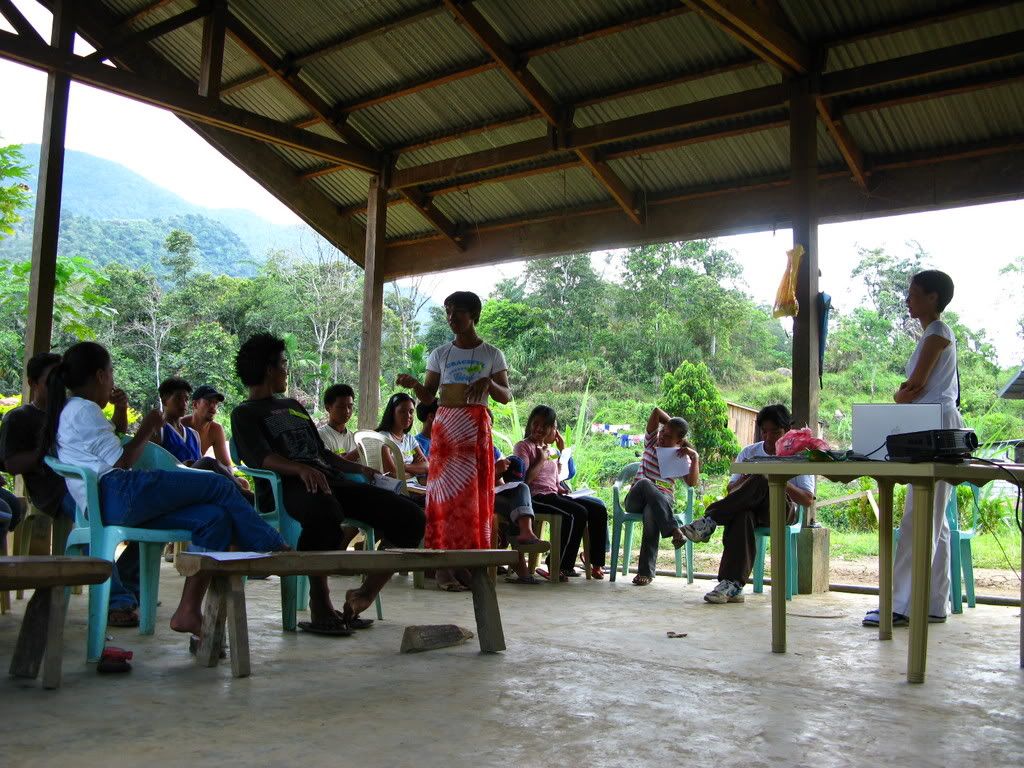
The other week, my colleague and I gave a workshop in Banaue, Ifugao Province.

I guided the participants through the basics of news writing while my colleague talked about design and layout-related matters.

It was our first workshop in Banaue -- and I must say, our first at a resort, the Banaue Ethnic Village Inn. The participants, however, were students from the four high schools of Asipulo. Also for the first time, we had older participants as well: the students' advisers, and the editorial staff of the LGU of Asipulo.

Aside from the change in location and environment, it was much like the previous workshops. The participants were there because they wanted to be able to write for and produce their newsletters.

But because it was a mixed group, we had a wider range of questions.

Some of the teachers and LGU staff showed much interest in the practical side of newsletter production -- offset printing and photocopying, for example. An LGU staff wanted to know if identifying people "left to right" in photo captions meant the viewers' left to right. A teacher asked me if the basics of news writing could be applied to the Filipino language, and if their newsletter could be in more than one language.

In all, it was interesting to have this surge of interest in producing school -- and for that matter, LGU -- newsletters. Our LGU contact, in particular, expressed concern that the absence of a newsletter among the community translated to their lack of awareness of ongoing community projects. Did the community members know, for example, that their LGU had bested all the other LGUs in the country to win an award for a community project?

All this should tell us that no matter how small the circulation or how few the pages, a newsletter has very real use -- especially in a remote town like Asipulo. With some areas yet to be electrified, and radio broadcasts and cellphone signals hard to come by, people have to rely on -- and even produce -- their own print media to keep the information flowing.


+++

There's more I'd like to say about this workshop: how inspiring it was to interact with the students and teachers, how gracious the owners and staff of the resort all were, how cold and crisp the air was in this part of Banaue, how verdant the mountains and trees were, how fresh the vegetables tasted, how special it felt to be served lemons when I had asked for calamansi. 

But my colleague has already blogged about all this. For a much better story, see her blog here. Anything I write after her account is, to be honest, a bit anticlimactic.

20 November 2008

ap photographer moved by readers' response

He could have snapped the photo and then disappeared from their lives. But he didn't.

Associated Press photographer Jerome Delay is a seasoned journalist who has taken many photos of war and refugees.

On November 6, he shot 11-year-old Protegee and her niece, three-year-old Reponse, in the town of Kiwanja in eastern Congo.

The girls had been separated from their families in the war in Congo. Delay's photo showed Protegee carrying a sobbing Reponse on her back, while wiping tears from her eyes with her shirt.

According to Delay's own account, he was "particularly moved" by the hundreds of emails that had poured in after the photo was published.

Himself a father, he set out to find the two girls and help reunite them with their family.

Delay's actions would seem to be atypical of photojournalists and journalists in general. Not every journalist would have done what he did.

Which causes one to wonder: Did Delay violate any rule or code of conduct?

Should he have just maintained distance between himself and the girls?

Are his actions something that other media practitioners should emulate?

Aside from the obvious risks, reporting on conflict situations -- especially on wars -- presents many challenges. The reporter must know how to cover such situations in a sensitive manner, showing the human conditions (grief, rage, fear, poverty, and so on) while giving space and due respect to the people in them.

It's not easy being a journalist in Delay's position. Reporting on conflict in any form can harden anyone.

What Delay did -- and I'm sure there are others who have performed or are performing similar acts of kindness -- was his duty not only as a journalist, but as a human being.

Another point worth making is that Delay was pushed to do what he did because of the reactions of readers.

When the audience responds positively to a journalist and his/her work, it can be a very powerful force.

All this made for a happy ending for Protegee, Reponse, and their family.

Read more about Delay, Protegee, and Reponse here.

17 August 2008

the trend towards entertainment news

An interesting story on the Newsbreak website by Aries Rufo, entitled "Changing media landscape sidelines labor stories" points to a growing trend: "less and less stories about work" and more and more stories on entertainment.

Quoting National Federation Italian Press President Roberto Natale, the story says that one of the causes is of this phenomenon is journalists and the owners of media organizations abdicating their "social role."

BBC's Steve Schifferes says the rise of the 24-hour news service also has something to do with it, as it lends itself to more "superficial" content.

The irony should not be lost on anyone. What Natale and Schifferes are saying here is that the culprits are 1) the gatekeepers themselves -- that is, those who determine what news is -- and 2) the media through which the news is transmitted.

Is this an international phenomenon? Even without hard figures, one would agree that there seems to be more showbiz news on local TV and print media than, say, even 5 years ago.

This might not necessarily mean that media organizations and practitioners are going soft. In the spirit of fairness, it would help to remember that the news industry does not exist in a vacuum. There is the audience, with its preferences for TV (and perhaps increasingly, the Internet) and for light news are a key factor here.

And then there is the availability of all sorts of information. What previously had to be dug up, researched, and reported by a resourceful and hardworking journalist can now be easily accessed online. With the gatekeeper function now in the hands of anyone with a computer and Internet connection, any information is now being passed off as news.

For now, it's hard to say where this is going, or what kind of news coverage we will have 5 years from now. It's a trend, after all.

Let's hope that's all it is -- a trend.

19 June 2008

"how was it?"

By now I'm sure everyone in the Philippine blogosphere has put in his/her two cents' worth about the kidnapping of ABS-CBN senior reporter Ces OreƱa Drilon and her companions cameraman Jimmy Encarnacion and Professor Octavio Dinampo.

I must admit, I haven't been following it much so I don't feel I can really comment.

But yesterday, after seeing her press conference on TV, I felt like I just had to say something.

Drilon, Encarnacion, and Dinampo were held for more than a week by the Abu Sayyaf. When they were finally released, they had to endure a 5-hour hike in the hinterlands of Sulu to get to where "friendly forces" were waiting for them.

At the press conference, a tired-looking Drilon gamely and bravely answered questions.

And then one reporter asked: "How was it?"

"How was it?" Drilon repeated the question, leaning forward, eyes on the reporter.

Was that a deliberate pause? And was it me or did her voice -- and her eyebrows -- rise a bit higher than usual?

One can only imagine what the woman had just gone through -- the terror, the mental and emotional anguish, the dark uncertainty of having your fate in the hands of a group such as the Abu Sayyaf, not to mention the living, eating, and sleeping conditions.

And after all that, she gets asked: "How was it?"

In that slight nanosecond of a pause, I remembered the reporter who asked a child trapped in the rubble after an earthquake (or was it a landslide), "Anong nararamdaman mo ngayon (What are you feeling now)?"

Drilon could have come up with a dozen snappy answers (in the tradition of the MAD series "Al Jaffee's 'Snappy Answers to Stupid Questions'") for the reporter.

But to her eternal credit, Drilon remained silent. The reporter asked a follow-up question.

I forget what that question was, but it must have been a more appropriate question, as Drilon answered.

At the risk of getting some snappy answers myself, I ask:

Can't we have a little more empathy for the people we interview?

Aren't there more sensitive questions we can ask in such situations?

Aren't there more effective ways to get soundbites or quotes?

Aren't there better ways to get the story?

03 June 2008

can the internet fill in the gaps?

I came across this talk by Alisa Miller on TED, entitled "Why we know less than ever about the world."

Miller, who heads Public Radio International, makes valid -- if not disturbing -- points about how the quality of news coverage in the US and on the Internet has dropped. So much so that today's young American knows more about Britney Spears and less about what's going on outside his country than his counterpart 20 years ago.

With much of international news dependent on coverage by US-owned networks, where does this leave the rest of us? Are non-Americans as much in the dark?

Can the Internet -- blogs and other alternative or indie news sites -- fill in the gaps in news coverage?

30 April 2008

what is news?


At a news writing workshop with the youth of Asipulo, Ifugao, we went through the preliminaries of defining the term "news."

Is news anything reported in the papers, on TV, or on the radio?

Is news anything that happens to a celebrity like Kris Aquino?

Could anything happening in their remote municipality be news?

The young people of Asipulo had a simple definition. To them, news is information that must be known and reported because it is important.

Given that they hadn't been taught the concept of news values before the workshop -- formally, at least -- the recognition of news as something that must be known (from the audience's perspective) and reported (from the journalist's perspective) is exactly what we were going for.

To them, the long lines to buy rice in Quezon City was news. The recent wedding of a foreigner slash community volunteer was news. The death of a community member would be news.

We talked about why some events would be considered news, and why some would not.

The difficulty in buying rice, for example, was of interest to them perhaps because it was an alien concept. As children of farmers, they could not imagine it ever happening in their locality.

They considered the wedding of the volunteer to be news because he was an important member of the community. The same was true of the death of a community member -- especially if s/he were an elder or a prominent figure.

One of the workshop participants related the concept of news to an advocacy: you report something because it is your advocacy. I must admit I didn't expect to hear this from them. Nevertheless, this is certainly true. Whether journalists acknowledge it or not, they are advocates of truth, democracy, development, justice, and peace.

Another thing that surprised me was when some of them asked about the killings or otherwise repression of journalists. This told me that they were somehow aware of the concept of freedom of expression and its importance.

The workshop was an enriching experience for me. I learned a lot through the perspective of an audience who are not media-savvy and who are in fact underrepresented in media.

I realized that young people -- in particular, this group in Asipulo, Ifugao -- have a lot to say, and that a newsletter such as the one they are planning to publish would indeed give them a voice.

And I remembered why and for whom we do what we do.

Thank you, Providential Youngsters Society!

01 December 2007

the fly on the wall

Reading Lillian Ross's book Reporting Back: Notes on Journalism, I came across a phrase I have not heard or read in a long time: "fly on the wall," a technique used in journalism.

Journalists were once thought of as flies on the wall -- that is, passive, impartial observers and documenters who report what they observe and see from the scene of a news event. Do such journalists still exist? Is this technique still effective?

Ross thinks that it is "craziness" to think of journalism in this way, and to teach would-be journalists to use this technique.

A reporter doing a story can't pretend to be invisible, let alone a fly; he or she is seen and heard and responded to by the people he or she is writing about; a reporter is always chemically involved in a story.


The job of the media has long ceased to be that of a mere fly on the wall. I don't know how journalism is taught in other schools, but our instructors never told us to be flies on the wall. They taught us to be active -- to engage both subject and audience, and to anticipate and ask the questions that our audience might ask.

In teaching us that reporting is all about being the public's eyes and ears, Dr. Eric Loo, head of the University of Wollongong Graduate School of Journalism, used the acronym ORACLE. A journalist's job, he says, is to observe, reflect and report, analyze, contextualize, learn, and enlighten.

I prefer the ORACLE framework of reporting, but I don't think Dr. Loo meant it to mean that journalists are supposed to know it all. There might be some "mysticism" to the fly on the wall technique, in a Zen sort of way -- and I have no doubt there are situations when it might be needed and it might actually work as well. But it seems to be a one-dimensional approach to a very complex job.

Observation is integral to a journalist's role, but it doesn't end there.

01 November 2007

the princess and the paparazzi

The Merriam-Webster Online Dictionary defines paparazzo as "a freelance photographer who aggressively pursues celebrities for the purpose of taking candid photographs." The term came into use after the 1959 film La dolce vita, by Federico Fellini, featured such a photographer whose name was Paparazzo.

The paparazzi -- plural form of "paparazzo" -- feed on the public's insatiable appetite for delving into the private lives of movie and television stars, politicians, and in Europe, royalty. The lens of the paparazzi's cameras function much as the lens of the microscope does: examining, enlarging, and exposing details of these celebrities' lives in the name of sensationalism and tabloid journalism. And for a quick but hefty buck; photos of public figures and celebrities, especially "exclusive" ones, sell.

The truth is, photos can tell a story much more eloquently and dramatically than words can. They have greater impact, according to the rawness of emotion captured through the lens. The paparazzi know this. But their purpose is different. Impact, in the case of the paparazzi, is measured in the fleeting and secret moments in the lives of celebrities, snapped while hiding in the bushes after hours of waiting in the dark, or while chasing the subject down a busy street. It is in what they are able to capture, and when: exclusive photos of this politician dating that actress, the first photos of the pregnant princess, the last photos of the celebrity couple together. And it is in how human or ordinary the stars are seen in the photos: they dine, shop, marry, divorce, make mistakes -- and yes, suffer fatal accidents, as mere mortals do.

Because of their methods -- not to mention the resulting photos -- the paparazzi have had run-ins with the celebrities they cover. The most famous controversy involving the paparazzi was 10 years ago, after a vehicular accident killed Princess Diana, Dodi Al Fayed, and their driver, Henri Paul. With the inquest into their deaths having already started at London's High Court, the paparazzi and their practices are once again thrust into public scrutiny.

According to a news report on BBC yesterday, a paparazzo named Romuald Rat called one of the British papers from the site of the accident. He was offering exclusive photos of Princess Diana -- taken as she lay dying -- for GBP300,000 (roughly USD600,000). The inquest also repeated witness accounts of the paparazzi at the scene, taking photos of the princess just seconds after the crash, instead of helping her and the other passengers in the car.

There is something so glaringly wrong with the picture of the crash site painted by these accounts. After all, in real life, one could only hope that anyone arriving at the scene of an accident would call for help or otherwise provide assistance to the injured. The fact that the paparazzi did not -- according to the statements of witnesses -- and even sought to capitalize on the accident, as in the case of Mr. Rat, speaks volumes about the ethics (or lack thereof) of that profession.

The evidence raises important ethical questions. How far will the paparazzi -- and all media practitioners, for that matter -- go to get the story? Would they break rules of conduct, overstep boundaries of human decency? Would the job take precedence over morality? 

Were the paparazzi directly responsible for the car crash, and ultimately for the death of Princess Diana and her companions? Should they be held accountable for it? These questions may very well be not just for the paparazzi, but for the tabloid editors, publishers, and readers whose demand for such photos necessitated the supply.

31 May 2007

advantage: internet

It's still a source of both amazement and amusement to me that from time to time, whenever I open my email, I'm offered links to articles from publications such as the International Herald Tribune or the New York Times. There was a time when I would never have had access to these publications -- and now, here they are, as accessible as anything, thanks to AdSense!

Getting news on the Internet has perks such as this. And though it is a new experience, to me, the use of the Internet as a news medium is a matter of course. In the days when radio fulfilled the need for speed, families gathered around it to listen to the news; why wait for the morning paper when you could hear the news in real time? Then came television, which not only proved to be instant but also more engaging and appealing. Hearing and seeing the news as it unfolded became more than a novelty. It became plain necessity. Not content with regularly scheduled news programs, we demanded hourly news updates, and from there, 24/7 cable news was born.

Which brings me back to the Internet. It is fast, it is capable of multisensory news delivery, and it is available 24/7. But more importantly, it is affordable. It has leveled the playing field for news organizations: small players can have as much (and as credible) of an online presence as the bigger establishments. Mainstream media organizations benefit from the Internet, but more so the alternative media -- those who would not have a fighting chance in the arena of print or broadcast, both of which are costly to manage and maintain.

The Internet's "free-for-all" nature, however, presents a challenge, especially for small organizations. This challenge is to stand out. It's a competition to capture and hold the reader's attention. After all, the Internet is for anyone and everyone with an agenda. Whether you are selling or buying, preaching or searching, educating or learning -- you can make the Internet work for you. Interestingly enough, it is the small groups -- more than the big players, who can provide variety in their news reports -- who use the Internet well. Mainstream media organizations, despite their resources and opportunities for expansion and skills training, seem stuck in providing nothing more than shovelware. Visit the web site of any major Filipino news agency, compare it with the day's print version, and you'll see what I mean.

But for organizations with no print version, the Internet provides a liberating experience. No more nagging anxiety that your story may be cut -- or worse, axed altogether -- due to lack of space. No more waiting for the following day to get your story out, or to publish an erratum. You get the benefit of multimedia capability and interactivity as well.

Hands down, the advantage seems to belong to the Internet. Traditionalists will argue that the Internet is a cold medium; there are rituals of getting your news from print or broadcast that the Internet will never be able to provide. Most of these rituals have to do with a sense of socialization or of having a common experience -- such as reading the morning news at the breakfast table, for instance. Or gathering around the radio or TV set with your family. However, iIn parts of the country where the literacy rate is low or there is no electricity, radio remains the medium of choice.)

Will the Internet ever replace print, radio, or TV as the news medium of choice? To be sure, there are many factors that will determine this. But on the whole, the Internet has greatly aided the delivery of news and the journalistic imperative. It has certainly changed things, and in a lot of ways, made things easier and more convenient. Journalists must take advantage of this and harness all that the Internet can offer. Ultimately, it can change the way news is presented and delivered -- and journalists must upgrade their skills and learn to view the news in light of convergence.

Shovelware or convergence? The choice is really up to journalists. The Internet is a liberating new medium, but writing and planning for it is not without its challenges. One thing I can say a journalist might miss is having something to clip and frame or paste in a scrapbook.

11 May 2007

two books

On 3 May, the Philippine media watchdog group Center for Media Freedom and Responsibility (CMFR) launched the primer Philippine Press Freedom Primer: Quick Answers to Your Questions at a forum on press freedom in Jakarta, Indonesia. The forum was organized jointly by the Unesco, the Southeast Asian Press Alliance (SEAPA), the Alliance of Independent Journalists (AJI) Indonesia, and the Indonesian Press Council.

The book contains information on laws that affect press freedom, and the codes of ethics of the country's various press organizations. It should be a valuable resource for students, researchers, and even the general public.

Back home in Manila, another book was launched, also on 3 May. Blood on Their Hands: Infanticide in India and Other Stories was launched at the Diamond Hotel at the Konrad Adenauer Asian Center for Journalism (ACFJ) at the Ateneo de Manila University's Second Emerging Leaders in Asia Forum.

Blood on Their Hands can be described as a book of firsts: it is actually a compilation of excerpts from the Master's Projects of ACFJ's first batch of MA Journ students, and is the first in ACFJ's "Projects in Asian Journalism" series.

With these books, as with books previously published on the topic, it is hoped that the standards of journalism in the Philippines and in the region can continue to be both reviewed and upheld.

20 January 2007

ever changing, ever constant

For years, journalists have been in control of what the news is, and when and how the public gets it. Now, they are learning -- they have to, anyway -- that they do not have a monopoly on this.

Not everyone who blogs/moblogs is a reporter or a journalist -- or wants to be -- but bloggers/mobloggers have speed, access to sources, and low-cost, portable technology on their side. Journalists will benefit from these tools with reduced production times. More importantly, blogs/moblogs are adding a new dimension to journalism, in the form of “user-generated content.” This opens the way for a two-way flow of news, which gives journalists a new source of news and information.

It makes no sense for journalists to be in competition with bloggers or mobloggers. Nor must they become complacent and leave all the work to the blogging/moblogging public. It is important to harness the potential of blogs/moblogs in newsgathering. But more than ever, journalists must be able to make sense of all the information out there, fact-checking, framing stories, and providing context -- skills that are necessary regardless of medium. They will have to separate the chaff from the grain.

As Howard Rheingold writes in “Moblogs Seen as a Crystal Ball for a New Era in Online Journalism:”

“… the most important remaining ingredient of a truly democratized electronic newsgathering is neither a kind of hardware nor a variety of software, but a species of literacy—widespread knowledge of how to use these tools to produce news stories that are attention-getting, non-trivial, and credible.

Journalism, if it to deserve the name,… is about the journalist’s intuition, integrity, courage, inquisitiveness, analytic and expressive capabilities, and above all, the trust the journalist has earned among readers.”

Journalists must continue to exercise their conscience in their work. Ethical standards must never be compromised by speed and technology. There is nothing wrong with speed -- but “instant” should not mean “reckless.” The ability to produce instant news must be balanced by sound judgment calls.

Blogging/moblogging will continue to change the way journalists work. Nevertheless, much will remain the same.

07 December 2006

it is not the medium

One of the issues raised last night during our first chat session was that of the quality of journalism in light of convergence. Technology, convergence, and speed should be tools for delivering the news -- not excuses for bad journalism. The principles of journalism defined by Bill Kovach and Tom Rosenstiel are not limited to one medium -- they should be practiced across media. Any journalist worth his salt should remain mindful of this.

Reflecting on this, I am reminded of Stephen Glass, formerly of The New Republic. Writing in Forbes.com, Adam Penenberg -- who kept digging until he uncovered Glass’s deception -- said, “It is ironic that online journalists have received bad press from the print media for shoddy reporting. But the truth is, bad journalism can be found anywhere. It is not the medium; it is the writer.”