Showing posts with label self. Show all posts

28 April 2008

an ifugao child


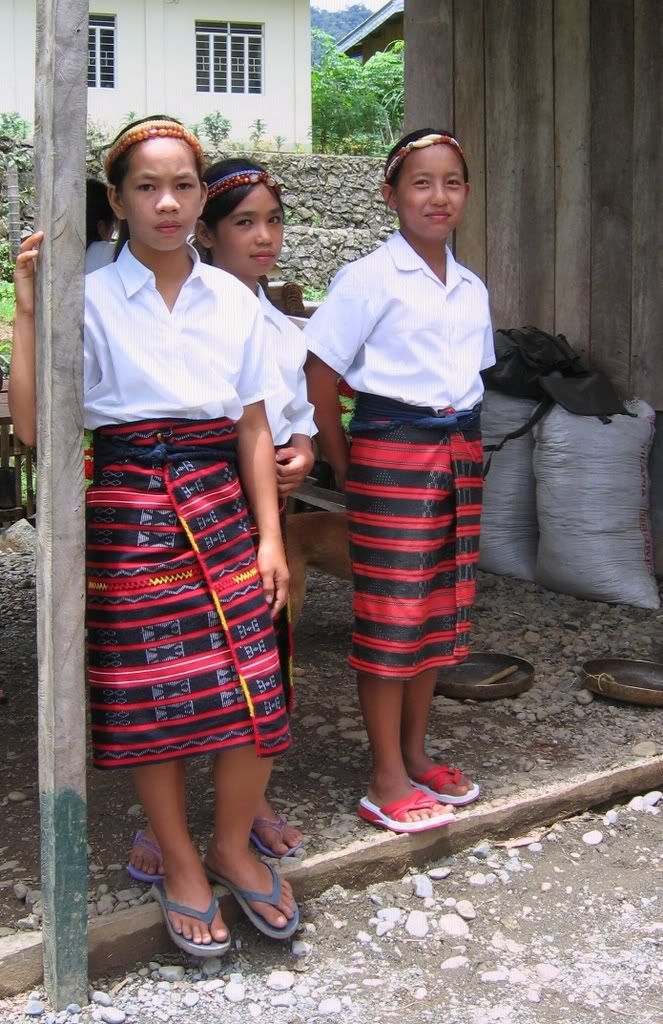
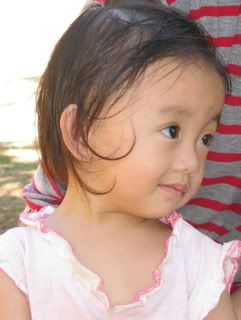
What will life be like for this Ifugao child?

Everyday, this child will wake to cheerful birdsongs and glorious sunrises. At night, she will be lulled to sleep by cool mountain breezes and the rhythmic calls of the crickets.

In time, she will learn the ways of her elders, and wear the colors of her tribe with pride. She will walk with the grace and dignity of her people, sure footed on even the steepest and most winding mountain trails. She will learn to work closely with Nature, knowing when the grains of rice will be ready for harvest, relying on the sun and the stars for the time, and the clouds for the weather.

And yet, this child will grow up differently.

As the times change, so will her future.

Another path is opening up to children like her. She will have more opportunities than those before her. The world will be at her feet.

She will have the best of both
tradition and modernity. She will retain the wisdom of her people, yet learn to harness technology for her needs.

She will stand tall beside people of other cultures, sure of her own identity. She will defend her rights -- as a woman, as an Ifugao, and as a person, above all -- and stand up for the rights of others.

Her spirit will soar, free and unfettered, even as she stays grounded in her reality. She will live with purpose, claiming all that is hers, and giving back all that she can.

With the grace of God, the love and support of her family, the blessings of Nature, and the benefit of a good education, this child will be all she can be.
16 April 2008

a national identity

In this age of globalization and the resulting homogenization of culture, does a Filipino identity stand any chance of surviving and prospering? Even without external influences, are our lifeways too diverse, the differences too pronounced, to produce a unified culture?

Section 3 of Republic Act 7356 discusses national identity this way:

Culture reflects and shapes values and beliefs and emulates the aspirations of the people’s cultural wisdom, thereby defining a people’s national identity. A Filipino national culture that mirrors Philippine economic, social, and political life shall be evolved, promoted and conserved.


Republic Act 7356, also known as "The Law Creating the National Commission for Culture and the Arts," defines culture as "a human right" in Section 2, as follows:

Culture is a manifestation of the freedom of belief and of expression, and is a human right to be accorded due respect and allowed to flourish.


Is it too naive or pretentious to think that the culture of the lowlands is as important as that of the seaside or the mountains? In Manila, a veritable melting pot, culture seems to be absent -- but this absence, of course, is in itself a culture. The farther away from Manila, the more evident the culture, it seems. Can one residing in a remote mountain barrio really embrace the culture of another on the opposite side of the country as being "Filipino?"

It is no big surprise that those living outside Manila strive to preserve their way of life. Take Filipino communities in other countries, for example. They seem more bent on celebrating, if not preserving, their Filipino-ness than the average Manileño.

Section 7 of the same law emphasizes the importance of preserving Filipino heritage:

It is the duty of every citizen to preserve and conserve the Filipino historical and cultural heritage and resources.


The reality is, no one can claim a monopoly on being Filipino or on living a Filipino life. Being Filipino is not just one particular characteristic or set or characteristics. Nor is it one dialect, one dress, one dish. One's duty to preserve and conserve is, simply, one's duty to be a Filipino.

09 April 2008

for whom?

When people hear the word "culture," they often think of expensive antiques, classical paintings and sculptures, fine dining, orchestras playing cerebral music, or high-society, black-tie events.

Such concepts, though not entirely unfounded, couldn't be more wrong.

Culture, as defined in the 1982 Mexico City Declaration on Cultural Policies, and approved by members of the United Nations Educational, Cultural and Scientific Organization (UNESCO) is:

...the whole complex of distinctive spiritual, material, intellectual and emotional features that characterize a society or social group. It includes not only the arts and letters, but also modes of life, the fundamental rights of the human being, value systems, traditions and beliefs.

This definition tells us that culture is simply how we live in a given time and place.

The Declaration goes on to affirm that:

...it is culture that gives man the ability to reflect upon himself. It is culture that makes us specifically
human, rational beings, endowed with a critical judgement and a sense of moral commitment. It is
through culture that we discern values and make choices. It is through culture that man expresses
himself, becomes aware of himself, recognizes his incompleteness, questions his own achievements,
seeks untiringly for new meanings and creates works through which he transcends his limitations.

The document lists more than 50 principles on culture and how it relates to development, democracy, education, communication, international cooperation, and peace.

Culture is therefore not limited in scope and object. It is as much a part of the life of the museum goer as it is the factory worker; the schoolboy and the matron; the businessman and the housewife; the call center agent and the market vendor.

It is for everyone.

30 December 2007

the round tuit

I came across this the other day, while surfing the Internet, and decided to post it as a yearender.

Upon Googling, I found that there are actually different designs, not to mention real -- as opposed to cyber, as in this case -- ones.

May we all get a round tuit!


THIS IS A TUIT.

Guard if with your life, as TUITS are hard to come by, expecially the round ones. This is an indispensable item. It will help you become a more efficient worker. For years we have heard people say, "I'll do it as soon as I get a ROUND TUIT." Now that you have one, you can accomplish all those things you put aside until you got a ROUND TUIT.


With thanks to the Roundtu-it Eco Caravan Park for the graphic.

31 October 2007

rituals and remembrances

It's not even All Souls' Day yet, but already the police are on heightened security, maintaining a presence at bus terminals and at the bigger cemeteries in Metro Manila where crowds have descended and are expected to continue to do so. Meanwhile, the news on TV earlier showed cars at a standstill on the expressway as Filipinos head for the provinces to remember the dead. The fact that this is a long weekend, on the heels of last weekend -- last Monday was a holiday, and so are tomorrow and Friday -- contributes to the traffic situation greatly.

It is interesting how deeply rooted in our culture the ritual of remembering those who have gone before is. It has a Christian origin, as the Church encourages the faithful to pray for the departed, especially those who are in purgatory. In fact, commemorating All Souls' Day with prayers and special rituals, after All Saints' Day on November 1, was begun by monastic orders. And with Christians comprising more than 80% of our population, the whole country is on a national holiday to observe All Souls' Day.

But I would think that even before the introduction of Christianity into our culture, the early Filipinos were already practising some sort of remembrance, as Asians. Ancestor worship is important to the Buddhists and the Taoists, and with the strong Chinese undertones in Filipino culture, I would say that our rituals of remembrance leans more towards this practice.

I'm not sure about early or indigenous Filipino practices of remembering the dead, nor about the practices of other faiths in the country (the Islamic community, for one). Definitely, we Filipinos have made these rituals of the East and West our very own -- and then some. We flock to the cemeteries with not just candles and flowers, or incense and offerings, as is applicable -- but also with tents, playing cards, mah jong sets, and karaoke machines. Our version of All Souls' Day has turned out to be not just a day to remember and honor the departed, but more so, an occasion to celebrate being alive, in true Pinoy fashion. I have no doubt that those going out of town are making the most of the trip, by visiting relatives. Or maybe even stopping by the beach.

Those in Manila who are unable to visit their loved ones' tombs in the provinces will have their own little rituals, lighting candles at home and offering prayers for their souls. In all this, we see how much of a melting pot the Philippines is. As with many things, we have integrated two influences -- the Christian practice of the West of remembering our departed loved ones, and the older Asian practice of ancestor worship. This makes us part of a larger community, the rituals of which continue to find expression in our culture.

06 August 2007

pinoy, and proud

Photo Sharing and Video Hosting at Photobucket

This is the winning entry in the Proudly Pinoy competition.

I had forgotten all about this until today. Reviewing the entries, it was interesting how the concepts of being Pinoy (Filipino) and of pride were translated as badges.

What makes a Filipino proud? What makes one proud to be a Filipino?

To all the participants, thank you for reminding us of our being Pinoy.

And to the organizers of the competition, thank you for the badge.

11 July 2007

self, identity, existence

Everyone has a story to tell.

Maybe my college friend, poet Ralph Semino Galan, was right when he said -- with apologies to René Descartes -- "I write, therefore I am."

Now, millions of people find their own little nook in cyberspace to tell their stories, assert their identities, define their existence. Their mantra -- again, apologies to Descartes, and also now to Ralph -- "I blog, therefore I am."

Blogging is different things to different people: a liberating experience, an exercise in democracy, and for some, a ritual for healing and self-expression. But as all these -- by no means a definitive list, I'm sure -- does blogging define us? Has it become a measure of identity and existence?

I ask this each time I have the urge to blog. The precious minutes of downtime that can be used for rest or study, I blog away. Not necessarily here, as I have more than one blog, as many bloggers do. The point is that we have associated ourselves so much with our blogs and with the act (and art) of blogging that to some, it is utterly unthinkable not to blog.

Of course, we are bigger than our blogs, our blog topics, and even blogosphere in general. The snippets of life that we manage to capture and note down, recorded in cyberspace -- virtual air, a system of 1's and 0's -- are precious, fleeting, and almost ethereal. But that's all they are: snippets. Life is too big to be encapsulated in a blog. It is too simple to be rendered as code, and too complex to be confined to bytes.

Simply put, a blog may be proof of one's existence -- not unlike a composer being remembered for his music or a painter being known for her art. Seen in this way, we are not only what we blog -- we are when we blog. We are as good as our blogs, with blog stats as our yardstick. We measure our worth by the number of blogs and sites linked to us. Badges and widgets, we wear with pride.

What then, if we are unable to maintain our blogs? Abandoned blogs -- are they like the "old, abandoned shells" in Antoine de Saint-Exupery's The Little Prince? The prince said there's nothing sad about old, abandoned shells. Can the same be said for abandoned blogs?

What happens to a blog or a site when its owner passes away? Julia Campbell's blog and the MySpace and FaceBook sites of the Virginia Tech students killed last April -- these are indelible proof of lives now gone. They're all that's left of a measure of space-time once spent on this earth. And for us who never knew them, they're desperate ways of connecting, getting to know, and paying tribute.

All this is a long way of saying that this blog may end up like theirs -- abandoned, for a time, as I give up blogging. At least while I work on completing my Master's Project -- which, again, is just another piece of who I am, proof of a facet or phase of my life as MA student.

I may use this blog to take note of my research... but only if time will allow it.

Everyone has a story to tell. And I have a story to write.