a worldwide moment
Among the many ways to celebrate 8 August 2008 (080808): World Wide Moment.
The trade-off: while I was in Paris, alumni of the MA Journalism program of the Konrad Adenauer Asian Center for Journallism (ACFJ) at the Ateneo de Manila University converged in Manila for a homecoming conference.
The conference was the 3rd Forum of Emerging Leaders in Asian Journalism held on 11 and 12 July at the Ateneo Loyola campus.
It turned out to be a productive gathering. Aside from the conference itself, the group met and decided on a number of things, among them:
The formal establishment of the Ateneo ACFJ Alumni Association: With alumni coming from many different countries in Asia and diverse backgrounds, this group has the makings of a solid network for cooperation and unity among journalists and media practitioners. From day one of the MA program, it was evident that we would make good contacts, if not friends, from across the region.
Putting up a blog for the association: In all things, we must practice what we preach. We profess to be producers and gatekeepers of information, so we ourselves must be able to keep up. Convergence and multimedia are the buzzwords of the day, and we must be able to talk the talk, as they say.
Read more about the conference here.

I actually considered buying one of these -- a little piece of French history, all my own -- but realized it would be of no use to me, as my French is extremely basic.
Aside from hello and how are you, I know only the barest minimum for survival:
Je ne comprends pas.
Parlez-vous anglais?
Je suis végétarienne/végétalienne. (I am a vegetarian/vegan.)

The annual conference of the Asian Media Information and Communication Centre (AMIC), held at the Manila Hotel this year, was an eye opener.
The list of topics and names on the program was certainly exhaustive enough to overwhelm. But to actually be there and see researchers and practitioners sharing their experiences and talking about future directions made one feel how diverse and dynamic the region and the field are.
The session on alternative media was an interesting mix of old and new: Sanskrit writings and their relationship to journalism principles, and a survey of community-based approaches to broadcasting as practised by Church-owned radio stations in the Philippines on the one hand; and citizen journalism as practised by a news organization in Malaysia, and a uses and gratifications analysis of Facebook uses at the University of Singapore, on the other.
It was an interesting session, not only because the presentations were interesting in themselves, but also for the selection of these presentations under the classification of alternative media. Indeed, the term "alternative" is broad enough to apply to old and new -- the traditional and the cutting-edge -- as represented by these topics from the societies of India, the Philippines, Malaysia, and Singapore.
During the conference, AMIC launched six new publications, including the Asian Communication Handbook 2008, Media and Conflict Reporting in Asia, and Media and Development in Asia: Regional Perspectives.
We recently had a news writing workshop with the members of the Providential Youngsters Society (PrYS)-Kiangan in Ifugao.
The young people of Kiangan, I discovered, are a lot more media-savvy than their counterparts from Asipulo -- a municipality where some barangays are not accessible except on foot and have no electricity.
Some participants attended the workshop with earphones glued to their ears.
After the workshop, some participants asked us if we had Friendster accounts.
How does their exposure to media affect them? How do they use it? Do they use it to their advantage? For research? For entertainment?
Do they feel empowered to use it to tell the world about their community? Or do they use it to get out of it?
If they could only feel empowered, think how much richer the national and even global dialogue would be. Citizen journalism is this dialogue, proof of empowerment, an alternative to the established media.
In the end, I believe that these young people can contribute. This is why we do these workshops: to help them contribute. A newsletter isn't just a newsletter -- it's citizen journalism.
Perhaps my hoping they'd be citizen journalists someday is too ambitious, but there are stories only they can write. There is knowledge only they can share. And there is a future only they can create.
----------------------
This photo shows PrYS organizer Gerald Puguon, Jr. accepting a book donation on behalf of PrYS. The books were given by the Konrad Adenauer Asian Center for Journalism (ACFJ) at the Ateneo de Manila University to support PrYS's efforts to publish a newsletter. 
I haven't been following the Ces Drilon kidnapping as much as I would have wanted to. So when I came across this story on inquirer.net, I begin to wish I had.
Here is an excerpt:
(PNP Director General Avelino) Razon said that if there was any lesson from the kidnapping, it was also to properly exercise press freedom.
"Ang aral po dito laging sinasabi hindi natin puwedeng i-exercise press freedom na malalagay ang [The lesson here is we can't exercise press freedom by putting] reporters or journalists in harm's way, na hawak ng terrorista or criminal elements," said Razon.
By now I'm sure everyone in the Philippine blogosphere has put in his/her two cents' worth about the kidnapping of ABS-CBN senior reporter Ces Oreña Drilon and her companions cameraman Jimmy Encarnacion and Professor Octavio Dinampo.
I must admit, I haven't been following it much so I don't feel I can really comment.
But yesterday, after seeing her press conference on TV, I felt like I just had to say something.
Drilon, Encarnacion, and Dinampo were held for more than a week by the Abu Sayyaf. When they were finally released, they had to endure a 5-hour hike in the hinterlands of Sulu to get to where "friendly forces" were waiting for them.
At the press conference, a tired-looking Drilon gamely and bravely answered questions.
And then one reporter asked: "How was it?"
"How was it?" Drilon repeated the question, leaning forward, eyes on the reporter.
Was that a deliberate pause? And was it me or did her voice -- and her eyebrows -- rise a bit higher than usual?
One can only imagine what the woman had just gone through -- the terror, the mental and emotional anguish, the dark uncertainty of having your fate in the hands of a group such as the Abu Sayyaf, not to mention the living, eating, and sleeping conditions.
And after all that, she gets asked: "How was it?"
In that slight nanosecond of a pause, I remembered the reporter who asked a child trapped in the rubble after an earthquake (or was it a landslide), "Anong nararamdaman mo ngayon (What are you feeling now)?"
Drilon could have come up with a dozen snappy answers (in the tradition of the MAD series "Al Jaffee's 'Snappy Answers to Stupid Questions'") for the reporter.
But to her eternal credit, Drilon remained silent. The reporter asked a follow-up question.
I forget what that question was, but it must have been a more appropriate question, as Drilon answered.
At the risk of getting some snappy answers myself, I ask:
Can't we have a little more empathy for the people we interview?
Aren't there more sensitive questions we can ask in such situations?
Aren't there more effective ways to get soundbites or quotes?
Aren't there better ways to get the story?
I came across this talk by Alisa Miller on TED, entitled "Why we know less than ever about the world."
Miller, who heads Public Radio International, makes valid -- if not disturbing -- points about how the quality of news coverage in the US and on the Internet has dropped. So much so that today's young American knows more about Britney Spears and less about what's going on outside his country than his counterpart 20 years ago.
With much of international news dependent on coverage by US-owned networks, where does this leave the rest of us? Are non-Americans as much in the dark?
Can the Internet -- blogs and other alternative or indie news sites -- fill in the gaps in news coverage?
A report posted yesterday on the CBCP News site urges Filipino Catholics to support the Church's media apostolate, as Catholics everywhere celebrate World Communications Day tomorrow.
I don't know how aware Filipino Catholics are about the media apostolate of the Church. In any case, the report caught my attention because it is related to my master's project.
media and vatican II
Even before the Vatican II conference, the Catholic Church had already recognized the importance of media in their mission. It was only during Vatican II, however, that they issued their first official document on the topic -- the Inter Mirifica.
The document introduced the term "social communication" -- a catchall for any form of interpersonal communication. This included media, literature, theater, film, dance, music, and the visual arts. The term is broad enough to include the Internet and even SMS.
A follow-up document called Communio et Progressio established the Church's media apostolate. It recommended that the Church set up media offices and assign priests, nuns, and lay workers to manage these offices.
Today, one will find a media office at almost every level of the Church hierarchy -- from the Vatican to the smallest local parish.
In the Philippines, there is the Catholic Bishops Conference of the Philippines (CBCP) Episcopal Commission for Social Communication and Media, the National Office of Mass Media, and media offices at the level of the archdiocese and diocese. Different congregations own and manage their own media arms. The secretary of the Federation of Asian Bishops Conferences Office of Social Communication (FABC-OSC) also holds office here.
why a media apostolate?
In the above Church documents, there is recognition that social communication -- including media -- is necessary as a means to evangelize.
Undoubtedly, the Catholic Church wields influence in Philippine society. It is active in the lives of most Filipinos, who are baptized, married, and buried in Catholic rites. Its presence is felt in even the smallest and remotest barrios, where parish priests are respected members of the community. Churches are crammed with faithful followers on at least two days of the year -- Easter Sunday and Christmas.
Considering the pervasiveness of the Catholic culture in our society, is a media apostolate still needed? On the other hand, are Church-owned or otherwise Catholic media effective in their mission of evangelizing or of deepening the faith of Filipino Catholics? Do Filipinos read Church-owned newspapers and publications, watch or listen to Catholic programs, or visit Church-run websites?
"a choice"
Bishop Bernardino Cortez, who heads the Episcopal Commission on Social Communication and Media, described Catholic media as "a choice" that allows us "to be strengthened in our faith" in confusing times.
After all is said and done, this is probably the best way to describe Catholic media: a choice. Such a choice would not be available in other countries, particularly those where freedom of expression is not guaranteed by the constitution. The presence of Church-owned media is, at the very least, an indication that we are still a democracy. We are still free -- free to worship as we please, free to choose what we read or watch or listen to, and free to decide for ourselves which course of action to take.
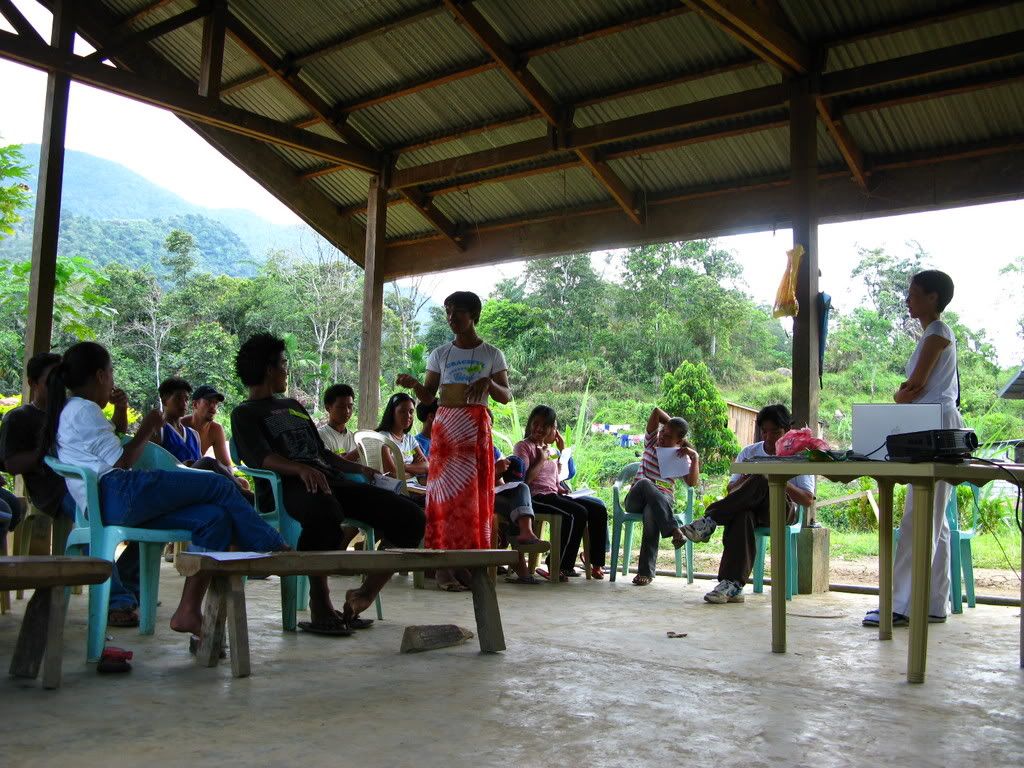
At a news writing workshop with the youth of Asipulo, Ifugao, we went through the preliminaries of defining the term "news."
Is news anything reported in the papers, on TV, or on the radio?
Is news anything that happens to a celebrity like Kris Aquino?
Could anything happening in their remote municipality be news?
The young people of Asipulo had a simple definition. To them, news is information that must be known and reported because it is important.
Given that they hadn't been taught the concept of news values before the workshop -- formally, at least -- the recognition of news as something that must be known (from the audience's perspective) and reported (from the journalist's perspective) is exactly what we were going for.
To them, the long lines to buy rice in Quezon City was news. The recent wedding of a foreigner slash community volunteer was news. The death of a community member would be news.
We talked about why some events would be considered news, and why some would not.
The difficulty in buying rice, for example, was of interest to them perhaps because it was an alien concept. As children of farmers, they could not imagine it ever happening in their locality.
They considered the wedding of the volunteer to be news because he was an important member of the community. The same was true of the death of a community member -- especially if s/he were an elder or a prominent figure.
One of the workshop participants related the concept of news to an advocacy: you report something because it is your advocacy. I must admit I didn't expect to hear this from them. Nevertheless, this is certainly true. Whether journalists acknowledge it or not, they are advocates of truth, democracy, development, justice, and peace.
Another thing that surprised me was when some of them asked about the killings or otherwise repression of journalists. This told me that they were somehow aware of the concept of freedom of expression and its importance.
The workshop was an enriching experience for me. I learned a lot through the perspective of an audience who are not media-savvy and who are in fact underrepresented in media.
I realized that young people -- in particular, this group in Asipulo, Ifugao -- have a lot to say, and that a newsletter such as the one they are planning to publish would indeed give them a voice.
And I remembered why and for whom we do what we do.
Thank you, Providential Youngsters Society!