22 June 2007

she loves me, she loves me not...

As I write this, Asia News Network associate editor and former Bandillo ng Palawan editor-in-chief Jofelle Tesorio is free again.

She was released after some 10 hours in prison. Why was she even there, to begin with, considering that she had already posted bail?

love-hate relationship
This happened just a day after the newspaper headlines screamed that President Gloria Macapagal Arroyo was seeking the media's help in the last leg of her presidency. It makes one wonder about her relationship with the Philippine press -- a love-hate relationship, to my mind.

I still remember that infamous press conference that members of the Foreign Correspondents' Association of the Philippines (FOCAP) were banned from attending. FOCAP members observed that not even the late President Marcos did such a thing.

Then came Proclamation 1017, which placed the country under a state of emergency. Though it lasted for just a week, it was enough to create a chilling effect. The office of The Daily Tribune was raided, and a military presence was established in other media organizations.

change of heart
And of course who can forget the First Gentleman's libel suits against some 40 journalists last year? These were all magnanimously dropped after Mr. Arroyo's successful heart surgery in April this year. Looks like he had a sudden change of heart (sorry, I couldn't resist the pun).

But he wasn't the only one. On 15 June, the Philippine Daily Inquirer carried a story about the President promising "to end the killing of journalists and protect them from libel suits and arbitrary arrest." She also called upon all journalists to join hands with her administration "in mutual trust and common purpose so that all the violence will be stopped."

Since Ms. Arroyo assumed office in 2001, 51 journalists have been killed.

ask not what the media can do...
This is undoubtedly a president who knows what the media can do for her and her administration.

She is aware that the media can play a huge role in the downfall of a president, as it did in the case of her predecessor. She knows how relentlessly the press can pursue a story to uncover the truth, as what happened in the "Hello, Garci" affair. And she feels the watchful gaze of international media and human rights organization who are determined to make her administration accountable for infringements on the freedom of the press.

Is she now eager to show what she can do for the media?

relief
The Philippine press heaved a collective sigh of relief as Jofelle walked out of detention in Quezon City. Whether this relief is temporary and short-lived will depend on whether the President makes good her promise to put a stop to the killing, suing, and arresting of journalists.

Read more about Jofelle's arrest here.

20 June 2007

the bugo-bugo in the senado

Along with Sen. Rodolfo Biazon, there are three newly elected retired or otherwise former military officers and graduates of the Philippine Military Academy in our Senate: Panfilo Lacson and Gregorio Honasan (PMA '71) and Antonio Trillanes (PMA '95).

I was able to catch the first part of the recent edition of ANC's "Strictly Politics" with all of these cavaliers (as PMA'ers are called) as guests, except for Trillanes. The fact that there are four of them in the Senate has become a cause for recent concern and discomfort. The presence of former military officers in the Cabinet and other areas of public service, and now in the Senate -- what is this, some kind of club? Unfortunately, the proverbial fuel was added to the fire with the statement of one of them, editorialized in the Philippine Daily Inquirer, a few days ago, that essentially -- yes, there is some sort of club.

My interest is the commonality among the four. What binds them together is the PMA experience -- the discipline, the values, and the lessons learned within the walls of Fort del Pilar as well as out on the field. It is not necessarily the same experience, but the bond exists, forged by a code of conduct we can only wonder about. Yet, is this bond enough for them not to go head to head over matters that may arise in the future?

Belongingness, as I mentioned in my previous post, stems from such commonalities. They all are PMA graduates, and so we can assume that to some extent, they shared one community. But years after the PMA, and with years apart among them (except for Honasan and Lacson, who were classmates) -- were their communities still the same? Was Biazon's cadet life the same or at least comparable to Trillanes'? What about Lacson and Honasan, mistahs though they are, did they experience the same military experiences after leaving the PMA?

I wanted to see where the discussion was going, but didn't have much time to watch. I stayed long enough to hear Sen. Honasan say that in the Senate, it's the national agenda they are pushing, not the agenda of the bugo-bugo -- a term of endearment used at first for plebes, and later, for fellow PMA'ers. Can we trust their definitions of the national agenda, considering the very different personalities and alignments of the four? All of them were involved in their own different interpretations of service to the nation at some point in their careers -- whether mutiny, coup d'etat, or defense.

Commonalities or not, their first duty -- as well as that of the other senators, for that matter -- is in the exercise of their responsibilities as elected senators. It is to the public, the people that elected them, that they must prove themselves and be accountable. Not to the PMA, as institution and community, and certainly not to the bugo-bugo.

15 June 2007

belonging

Today, I went to school and waited for my turn to have some papers processed. I was one of only three graduate students in the waiting area, apparent not only by our dress, but also by the fact that we three were the only ones unaccompanied by friends -- and therefore, the only ones who were quiet. Most interesting was the conversation going on around us during that wait. Everyone was speaking in English. If anyone spoke in Pilipino, it was with a distinct non-Filipino accent, or it was actually Taglish.

One guy was engaged in a particularly loud and annimated conversation with another guy. His speech was peppered with four-letter words:

...and then, you know, this guy was beating the **** out of him! He was really like... wow, man... **** talaga!

Sitting there, I felt a bit out of place, not just because of the difference in age -- I'm almost sure these kids would call me "ma'am" or say "po" when talking to me -- but because of the difference in language.

I got the same feeling not long ago, before a recent trip up north (part of which I blogged about here). Standing in line to get a ticket at the bus station, I felt as if I were no longer in Manila. The dispatcher and everyone in line ahead of me were transacting business in Ilocano. One could tell that this bus was bound for the north, where Ilocano is spoken; in fact, this bus company made trips only to that part of the country.

Again, the language was a hindrance. I could understand snatches of conversation, but on the whole, it was a different culture altogether. Similarly, though the teenagers in the first incident were speaking in a language I understood very well, the difference in how we used this language was the key.

These experiences represent two different communities -- that of the undergraduate students of that particular university, and that of the Ilocano speakers. A community assumes many things. A shared language is one of them. With close to 200 dialects spoken in the Philippines, is it any wonder that regionalism exists? A given locality can speak more than one dialect or language, in fact, and this makes it all the more challenging.

More than a shared language, a community also involves shared ideas and the shaping of a common world view. In particular, I refer to a discourse community -- one in which participation means the use of jargon or terms and, at the very least, familiarity with the written and spoken train of thought unique to the community. The world view of that male teenager who spoke English as an American his age might, for instance, would be entirely different from that of the bus company dispatcher who spoke Ilocano and perhaps very little Tagalog or even Pilipino. Even if they lived in the same locality, their very perceptions of that locality would be different.

What language could the Philippines lay claim to as a national language? What world view would this language produce and represent? In my experience, when some residents of Asipulo wanted to communicate with me, they did so in English. This may represent the hopes and aspirations of many Filipinos, but certainly not their daily experience.

If there are as many world views as there are tribes and dialects in our country, what is to define our sense of belonging? When national events unfold and are represented and reported in media in a language that a great many people cannot relate to or worse, do not understand, belongingness must be found in other forms, through other commonalities.

12 June 2007

mabuhay!


I'm posting this video of Lupang Hinirang as a reminder that Philippine society is far from perfect.

Not all our presidents were great. Not all our heroes were selfless. Not all our athletes bring home the gold. Not all our public servants are noble. Not all our families are happy and intact. And not all our babies are healthy and well cared for.

It will take some time before we are rid of all our ills and become the people we want to be.

In the meantime, we are free. And while we are free, there is hope.

Mabuhay!

07 June 2007

a real community

In his book Imagined Communities: Reflections on the Origin and Spread of Nationalism, anthropologist Benedict Anderson defines a nation as "an imagined political community":

It is imagined because the members of even the smallest nation will never know most of their fellow-members, meet them, or even hear of them, yet in the minds of each lives the image of their communion.... (A)ll communities larger than primordial villages of face-to-face contact (and perhaps even these) are imagined. Communities are to be distinguished, not by their falsity/genuineness, but by the style in which they are imagined....

The nation is imagined as limited because even the largest of them encompassing perhaps a billion living human beings, has finite, if elastic boundaries, beyond which lie other nations. No nation imagines itself coterminous with mankind. The most messianic nationalists do not dream of a day when all the members of the human race will join their nation in the way that it was possible, in certain epochs, for, say, Christians to dream of a wholly Christian planet....

Finally, it is imagined as a community, because, regardless of the actual inequality and exploitation that may prevail in each, the nation is always conceived as a deep, horizontal comradeship. Ultimately it is this fraternity that makes it possible, over the past two centuries, for so many millions of people, not so much to kill, as willingly to die for such limited imaginings.


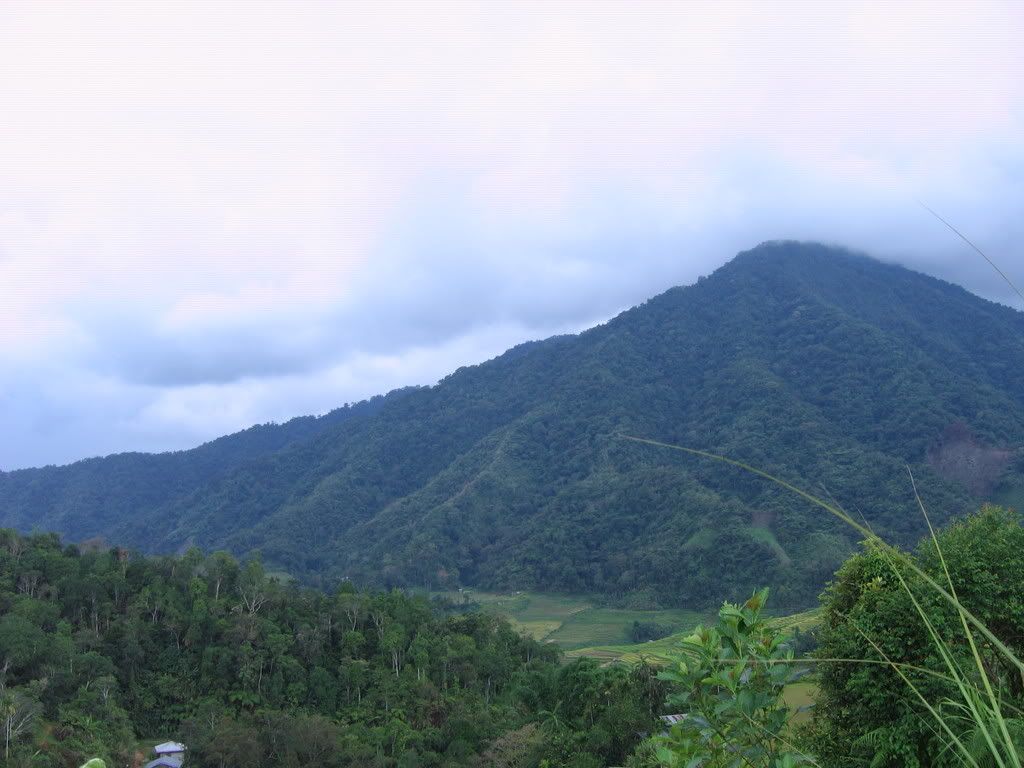
I remembered this a few days ago as I looked out over the mountains of Ifugao Province, en route by tricycle to the municipality of Asipulo from Kiangan. The trip was nearly an hour over roads that were thankfully concrete in some places, rough and bumpy in most, and generally winding up and down through some of the prettiest views I had ever seen in my life.

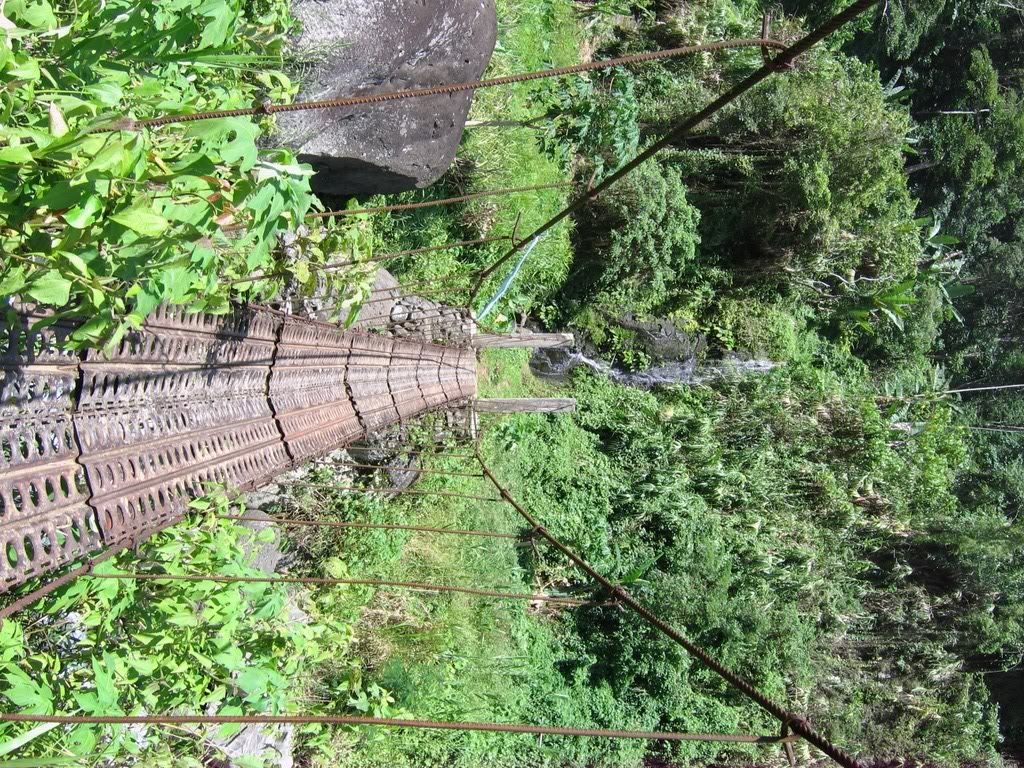
The farmers who hosted our stay in Sitio Pula and the locals who guided us through the thick mountain forest -- what did I have in common with them? Not geographic location, nor way of life, nor language. The place I've called home for most of my life seems a world away from here; the dialect I speak (Tagalog) is foreign to these people. The mountain trail that took me a painful hour to traverse (and not without their help and patience, I might add), they breeze through in half or even a quarter of that time. Indeed, we measure time differently -- they, by seasons of planting and harvest, and I, by semesters and projects.

They would probably never understand what I do -- how I can spend up to hours in front of a computer in my little room, my dependence on an unseen yet powerful thing called the Internet that travels through cables and allows me to reach out to other members of a community not only imagined but also perhaps previously unheard of. In the same way, try as I might, I would probably never fully grasp what life on a mountain is really like -- how to read the signs of the sky and the earth, how to live in harmony with Nature and with other beings who make the mountain their home.

But in our minds, did "the image of our communion" already exist even before we met? Did we each imagine that hundreds and thousands of kilometers away from our homes were people who led lives the polar opposite of our own? They, Ifugao, and I, ManileƱa -- did we see ourselves as actually sharing a nationality, a Filipino-ness? Did the fact that we are both Filipino -- a term that signifies membership in this imagined community -- compel us to appreciate each other before we had even met? And having met, did we find that we shared more than what we had ever imagined?

In Asipulo, I was in a totally different place from where I live, in a situation I would not quite have imagined myself to be, amid people who were strangers to me. Yet, I felt I belonged, perhaps because this place was part of my nation -- imagined or not -- but more importantly, because the people recognized in me a co-member in a very real community called mankind.

And recognizing me as such, the people of Asipulo reached out to me, as I did to them, shared their food and their homes, offered me a glimpse into their lives -- and simply made me feel welcome.

01 June 2007

the peace agenda

One of the topics I've been thinking of focusing on when I do my master's project is peace journalism, or the peace initiatives of Philippine media. Obviously, this is still very broad, but my interest in this stems from the idealistic notion that journalists can contribute to peace as they go about their work.

Ten years ago, the term "peace journalism" first came into use when Professor John Galtung of Peace Studies and Peace Research lectured at the Summer School at Taplow Court in the UK. Since then, the term has been used to both refer to and recognize approaches to reporting conflict that focus on peace initiatives, and ultimately, promote nonviolence.

This is not to say that peace journalism is new. I remember Carol Arguillas of MindaNews saying that she'd been practising journalism from a peace perspective for years without knowing that there was a name for it. Indeed, the term "peace journalism" can be applied to any journalist's efforts to report on war or conflict situations guided by conscience and from the desire to bring about change.

The history of wars and other conflicts played out throughout the world shows proof of the media's role in either perpetuating such conflicts or helping to end them. The truth is, we have gotten so used to the "conflict frame" -- "A versus B" or "us versus them," a two-dimensional, myopic approach that tends to pit a protagonist against a sometimes unwitting antagonist -- that we forget that there are other options, other angles, and other players. The coverage of the Subic rape case, for example, was done mostly from the frame of "Nicole" versus Daniel Smith, female versus male, or even the Philippines versus the US. Other media practitioners did well to go a step further, and reported on the impact of the Balikatan exercises in general, the Visiting Forces Agreement, and the history of crimes committed by US military personnel while here.

A conflict frame ends up justifying the conflict in the guise of rallying the public in support of the cause, and soon leads to divisiveness. This is what happened during the Vietnam War, when the media were initially manipulated for the purposes of propaganda. We see this locally as well, with the use of such terms as "Muslim rebels" or "Muslim extremists" by the media, reflecting a bias against those who are not of the dominant religion. Though perhaps done unconsciously, it is unfair and damaging. Why not "Catholic murderer" or "Protestant corrupt official" then?

Peace journalism provides a more holistic approach to the coverage of conflict, one that considers all sides without making judgments, focuses on the goals of the different parties, and allows for solutions. Where there is war or any sort of conflict or violence, there is the opportunity for journalists to report from such a perspective. Doing so sends a strong message to the audience and will go a long way in contributing to peace. But beyond the presence of war or conflict, peace journalism can be practised anytime -- as a conscious effort to prevent future conflict, no matter what the status quo.

31 May 2007

advantage: internet

It's still a source of both amazement and amusement to me that from time to time, whenever I open my email, I'm offered links to articles from publications such as the International Herald Tribune or the New York Times. There was a time when I would never have had access to these publications -- and now, here they are, as accessible as anything, thanks to AdSense!

Getting news on the Internet has perks such as this. And though it is a new experience, to me, the use of the Internet as a news medium is a matter of course. In the days when radio fulfilled the need for speed, families gathered around it to listen to the news; why wait for the morning paper when you could hear the news in real time? Then came television, which not only proved to be instant but also more engaging and appealing. Hearing and seeing the news as it unfolded became more than a novelty. It became plain necessity. Not content with regularly scheduled news programs, we demanded hourly news updates, and from there, 24/7 cable news was born.

Which brings me back to the Internet. It is fast, it is capable of multisensory news delivery, and it is available 24/7. But more importantly, it is affordable. It has leveled the playing field for news organizations: small players can have as much (and as credible) of an online presence as the bigger establishments. Mainstream media organizations benefit from the Internet, but more so the alternative media -- those who would not have a fighting chance in the arena of print or broadcast, both of which are costly to manage and maintain.

The Internet's "free-for-all" nature, however, presents a challenge, especially for small organizations. This challenge is to stand out. It's a competition to capture and hold the reader's attention. After all, the Internet is for anyone and everyone with an agenda. Whether you are selling or buying, preaching or searching, educating or learning -- you can make the Internet work for you. Interestingly enough, it is the small groups -- more than the big players, who can provide variety in their news reports -- who use the Internet well. Mainstream media organizations, despite their resources and opportunities for expansion and skills training, seem stuck in providing nothing more than shovelware. Visit the web site of any major Filipino news agency, compare it with the day's print version, and you'll see what I mean.

But for organizations with no print version, the Internet provides a liberating experience. No more nagging anxiety that your story may be cut -- or worse, axed altogether -- due to lack of space. No more waiting for the following day to get your story out, or to publish an erratum. You get the benefit of multimedia capability and interactivity as well.

Hands down, the advantage seems to belong to the Internet. Traditionalists will argue that the Internet is a cold medium; there are rituals of getting your news from print or broadcast that the Internet will never be able to provide. Most of these rituals have to do with a sense of socialization or of having a common experience -- such as reading the morning news at the breakfast table, for instance. Or gathering around the radio or TV set with your family. However, iIn parts of the country where the literacy rate is low or there is no electricity, radio remains the medium of choice.)

Will the Internet ever replace print, radio, or TV as the news medium of choice? To be sure, there are many factors that will determine this. But on the whole, the Internet has greatly aided the delivery of news and the journalistic imperative. It has certainly changed things, and in a lot of ways, made things easier and more convenient. Journalists must take advantage of this and harness all that the Internet can offer. Ultimately, it can change the way news is presented and delivered -- and journalists must upgrade their skills and learn to view the news in light of convergence.

Shovelware or convergence? The choice is really up to journalists. The Internet is a liberating new medium, but writing and planning for it is not without its challenges. One thing I can say a journalist might miss is having something to clip and frame or paste in a scrapbook.

14 May 2007

real people power

This year's election has left more than 100 people dead since the campaign started -- 114, according to Inquirer.net, and 116, according to International Herald Tribune. Five of these people were killed today alone.

These figures are lower than those for the 2004 elections. And though still not violence-free, elections 2007 has already been called peaceful and clean. Hopefully, this is not a premature proclamation.

Despite the violence, this has been more of a democratic exercise than ever. Inquirer.net's election coverage includes a blog site that accepts posts from readers, while on ANC, photo and video contributions from citizen journalists have been encouraged in TV spots that sell the idea of going beyond voter education to "voter empowerment."

And in the end, that's what this is all about: putting the power back into the people's hands. It is about the voter -- the Filipino -- his voice, his hope. It is about how empowered he feels and how much he values his vote, despite -- or maybe, more properly, because of -- the killings, the cheating, and the politician's promises.

Let us hope the people elected today never forget this.

11 May 2007

two books

On 3 May, the Philippine media watchdog group Center for Media Freedom and Responsibility (CMFR) launched the primer Philippine Press Freedom Primer: Quick Answers to Your Questions at a forum on press freedom in Jakarta, Indonesia. The forum was organized jointly by the Unesco, the Southeast Asian Press Alliance (SEAPA), the Alliance of Independent Journalists (AJI) Indonesia, and the Indonesian Press Council.

The book contains information on laws that affect press freedom, and the codes of ethics of the country's various press organizations. It should be a valuable resource for students, researchers, and even the general public.

Back home in Manila, another book was launched, also on 3 May. Blood on Their Hands: Infanticide in India and Other Stories was launched at the Diamond Hotel at the Konrad Adenauer Asian Center for Journalism (ACFJ) at the Ateneo de Manila University's Second Emerging Leaders in Asia Forum.

Blood on Their Hands can be described as a book of firsts: it is actually a compilation of excerpts from the Master's Projects of ACFJ's first batch of MA Journ students, and is the first in ACFJ's "Projects in Asian Journalism" series.

With these books, as with books previously published on the topic, it is hoped that the standards of journalism in the Philippines and in the region can continue to be both reviewed and upheld.

03 May 2007

world press freedom day 2007

In 1993, the United Nations General Assembly first proclaimed 3 May of every year to be a day to celebrate the freedom of the press.

More than ever, these are dangerous times to be a journalist. According to the Unesco, the Iraq War has been "the deadliest conflict for media professionals since the Second World War" -- with 137 journalists and media staff killed in the line of duty since the war began.

Other circumstances, not only war, can present danger to journalists. Journalists are not spared from election-related violence, for instance. The ambush of PDI's Delfin Mallari, Jr. and DZMM's Johnny Glorioso is a clear example; more so, the murder of DZRB's Carmelo Palacios just the day before.

Even in "peace-time" Philippines, journalists are ambushed on the road, shot on their way home from work. Worse, they are killed with impunity in their own homes, in the presence of their families.

Anywhere journalists are killed for doing their jobs, thrown in prison from speaking out, or bribed to shut them up -- the press is not free. The irony is that anywhere these crimes are committed, the press is most needed.

Here's to a free press, and a free world!